


Page 81 - AC-2-2
P. 81
Arts & Communication                                                    Digital reconstitution of lost heritage


            which guided the architectural reconstruction. For the
            textural elements, Quixel Megascans, a comprehensive
            library of high-resolution scans, provided the base
            textures. Arabescato marble scans were used to simulate
            marble components, while a template of reclaimed wood
            emulated the wooden flooring, walls, and ceilings. The
            intricate details, such as room drapery, drew inspiration
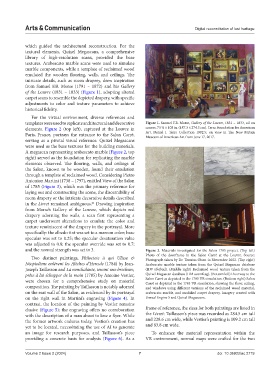
            from Samuel F.B. Morse (1791 – 1872) and his  Gallery
            of the Louvre (1831 – 1833) (Figure 1), adopting altered
            carpet scans to resemble the depicted drapery, with specific
            adjustments to color and texture parameters to achieve
            historical fidelity.
              For the virtual environment, diverse references and
            templates were used to replicate architectural and decorative   Figure 1. Samuel F.B. Morse, Gallery of the Louvre, 1831 – 1833, oil on
            elements.  Figure  2  (top  left),  captured  at  the  Louvre  in   canvas, 73 ¾ × 108 in. (187.3 × 274.3 cm). Terra Foundation for American
            Paris, France, portrays the entrance to the Salon Carré,   Art,  Daniel J. Terra Collection  1992.5; on view in The  New Britain
                                                               Museum of American Art from June 17, 2017.
            serving  as  a  pivotal  visual  reference.  Quixel  Megascans
            were used as the base textures for the building materials.
            A megascan representing arabescato marble (Figure 2, top
            right) served as the foundation for replicating the marble
            elements observed. The flooring, walls, and ceilings of
            the Salon, known to be wooden, found their emulation
            through a template of reclaimed wood. Considering Pietro
            Antonion Martini (1738 – 1797), entitled View of the Salon
            of 1785 (Figure 3), which was the primary reference for
            laying out and constructing the scene, the discernibility of
            room drapery or the intricate decorative details described
            in the Livret remained ambiguous.  Drawing inspiration
                                        61
            from Morse’s Gallery of the Louvre, which depicts red
            drapery adorning the  walls,  a  scan  first  representing  a
            carpet  underwent  alterations  to  emulate  the  color  and
            texture reminiscent of the drapery in the portrayal. More
            specifically: the albedo tint was set to a maroon color; base
            specular was set to 0.25; the specular desaturation value
            was adjusted to 0.8; the specular override was set to 0.7;
            and the normal strength was set to 3.              Figure  2. Materials investigated for the Salon 1785 project. (Top left)
              Two distinct paintings,  Philoctete à qui Ulisse &   Photo of the doorframe in the Salon Carré at the Louvre. Source:
                                                               Photograph taken by Dr. Trenton Olsen in November 2022. (Top right)
            Néoptolème enlèvent les Alèches d’Hercule (1784) by Jean-  Arabescato marble texture taken from the Quixel Megascan database
            Joseph Taillasson and La nonchalante, tenant une brochure,   (ID# ufojbixl). (Middle right) Reclaimed wood texture taken from the
            prête à lui échapper de la main (1785) by Antoine Vestier,   Quixel Megascan database (ID# ucemfcsg). (Bottom left) Doorway to the
            were chosen for a comprehensive study on material   Salon Carré as depicted in the 1785 VR simulation. (Bottom right) Salon
                                                               Carré as depicted in the 1785 VR simulation, showing the floor, ceiling,
            composition. The painting by Taillasson is notably adorned   and windows using different versions of the reclaimed wood material,
            on the east wall of the Salon, as evidenced by its portrayal   arabescato marble, and modified carpet drapery. Imagery created with
            on the right wall in Martini’s engraving (Figure  4). In   Unreal Engine 5 and Quixel Megascans.
            contrast, the location of the painting by Vestier remains
            elusive (Figure 5); the engraving offers no corroboration   frame of reference, the sizes for both paintings are listed in
            with the description of a man about to lose a flyer. While   the Livret: Taillasson’s piece was recorded as 284.5 cm tall
            the former artwork endures today, Vestier’s creation has   and 228.6 cm wide, while Vestier’s painting is 109.2 cm tall
            yet to be located, necessitating the use of AI to generate   and 83.8 cm wide.
            an image for research purposes, and Taillasson’s piece   To enhance the material representation within the
            providing a concrete basis for analysis (Figure 6). As a   VR environment, normal maps were crafted for the two


            Volume 2 Issue 2 (2024)                         7                                doi: 10.36922/ac.2719

