


Page 82 - AC-2-2
P. 82
Arts & Communication                                                    Digital reconstitution of lost heritage


            selected paintings. Initial steps involved embossing the   and 0.05, respectively.
            original images by adjusting brightness and contrast
            settings, preserving brush strokes’ visibility while   5. Recommendations
            mitigating background noise. These embossed renditions   Drawing on the results from the digital recreation of the
            served as bump maps and were processed through a   1785 Salon, focusing on Jean-Joseph Taillasson’s Philoctete
            dedicated normal map generator (https://cpetry.github.  à qui Ulisse & Néoptolème enlèvent les Alèches d’Hercule and
            io/NormalMap-Online/; accessed January 6, 2024).   the AI reconstruction of Antoine Vestier’s La nonchalante,
            Specific settings included: a strength value of 2; a level   several key recommendations emerge to guide future
            setting of 8; blur/sharpness intensity set to 2; utilization of   endeavors in the digital reconstruction of cultural heritage.
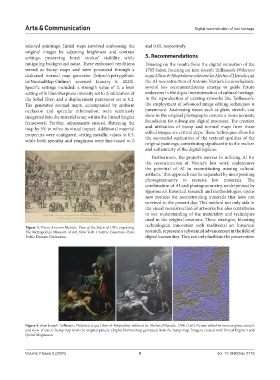
            the Sobel filter; and a displacement parameter set at 0.2.   In the reproduction of existing artworks like Taillasson’s,
            The generated normal maps, accompanied by ambient   the employment of advanced image editing techniques is
            occlusion and specular information, were seamlessly   paramount. Addressing issues such as glare, stretch, and
            integrated into the material setup within the Unreal Engine   skew in the original photographs ensures a more accurate
            framework. Further, adjustments ensued, flattening the   foundation for subsequent digital processes. The creation
            map by 5% to refine its visual impact. Additional material   and utilization of bump and normal maps from these
            properties were configured, setting metallic values to 0.3,   edited images are critical steps. These techniques allow for
                                                               the successful replication of the textural qualities of the
            while both specular and roughness were fine-tuned to 0
                                                               original paintings, contributing significantly to the realism
                                                               and authenticity of the digital replicas.
                                                                 Furthermore, the project’s success in utilizing AI for
                                                               the reconstruction of Vestier’s lost work underscores
                                                               the potential of AI in reconstituting missing cultural
                                                               artifacts. This approach can be expanded by incorporating
                                                               photogrammetry to recreate lost materials. The
                                                               combination of AI and photogrammetry, underpinned by
                                                               rigorous art historical research and methodologies, opens
                                                               new avenues for reconstructing materials that have not
                                                               survived to the present day. This method not only aids in
                                                               the visual reconstruction of artworks but also contributes
                                                               to our understanding of the materiality and techniques
                                                               used in the original creations. These strategies, blending
                                                               technological  innovation  with  traditional  art  historical
            Figure 3. Pietro Antonio Martini, View of the Salon of 1785, engraving.
            The Metropolitan Museum of Art, New York. Creative Commons Zero,   research, represent a substantial advancement in the field of
            Public Domain Dedication.                          digital humanities. They not only facilitate the preservation


            Figure 4. Jean-Joseph Taillasson, Philoctete à qui Ulisse & Néoptolème enlèvent les Alèches d’Hercule, 1784. (Left) Picture edited to remove glare, stretch,
            and skew. (Center) Bump map from the original picture. (Right) Normal map generated from the bump map. Imagery created with Unreal Engine 5 and
            Quixel Megascans.


            Volume 2 Issue 2 (2024)                         8                                doi: 10.36922/ac.2719

