


Page 92 - AC-2-2
P. 92
Arts & Communication                                              75 years of Macedonian ballet (1949 – 2024)


            central character was Yugoslav leader Josip Broz Tito and
            episodes of the People’s Liberation War were presented.
            The  critics  of  this  performance  wrote  that  it  is  “one  of
            the most successful contemporary works with patriotic
            themes,” 22(p.50)  confirming the positions expressed above.
              The new dance esthetics (techniques already
            established  in  the  West  and  widely  used),  that is,  the
            breakthrough of fresh currents, intensified in the seasons
            1991/92 when Macedonia proclaimed its independence.
            The need to achieve a modern dance style was also
            reflected  in  MNT’s  repertoire.  Several  choreographers
            (Iskra Shukarova, Igor Kirov, Sasha Eftimova) had the
            opportunity for education in western dance centers and
            eloquently portray the various modern and contemporary
            styles and scenic practices in their choreographies. In
            these performances, especially since the late 1990s,
            a corpus of performances was finally formed. The
            performances became modern/contemporary in the true
            sense regarding form, choreography, and style. This was
            the right course, as confirmed by the ballet’s final premiere
            in 2023. The performance was especially significant. The
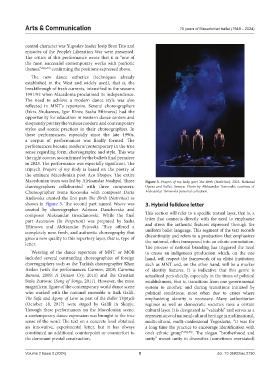
            triptych  Prayers of my Body  is based on the poetry of
            the eminent Macedonian poet Aco Shopov. The entire
            Macedonian team was led by Aleksandar Noshpal. Three   Figure 3. Prayers of my body, part The Birth (Nativitas), 2023. National
            choreographers collaborated with three composers.   Opera and Ballet. Source: Photo by Aleksandar Tomovski; courtesy of
            Choreographer Ivana Kocevska with composer Daria   Aleksandar Tomovski personal collection.
            Andovska created the first part The Birth (Nativitas) as
            shown in Figure 3. The second part named Weave was   3. Hybrid folklore letter
            created by choreographer Adriana Danchevska and
            composer Aleksandar Grozdanovski. While the final   This section will refer to a specific textual layer, that is, a
            part  Ascension (In Perpetum) was prepared by Sasha   letter  that  connects  directly  with  the need to  emphasize
            Eftimova and Aleksandar Pejovski. They offered a   and stress the authentic features expressed through the
            completely new, fresh, and authentic choreography that   uniform ballet language. This segment of the text records
            gives a new quality to this repertory layer, that is, type of   discontinuity and refers to a production that emphasizes
            letter.                                            the national, often transposed into an ethnic connotation.
                                                               The process of national branding has triggered the need
              Weaving of the dance repertoire of MNT or MOB    to create an indigenous production which, on the one
            included several outstanding choreographies of foreign   hand, will respect the framework of an elitist institution
            choreographers such as the Turkish choreographer Khan   such as MNT and, on the other hand, will be a marker
            Arslan (with the performances  Carmen, 2008;  Carmina   of identity features. It is indicative that this genre is
            Burana, 2009;  A Distant Cry,  2011) and the Croatian   actualized periodically, especially in the times of political
            Staša Zurovac (Song of Songs, 2011). However, the most   establishment, that is, transitions from one governmental
            magnificent figure of the contemporary world dance scene   system  to  another,  and  during  transitions  initiated  by
            who worked with the national ensemble is Itzik Galili.   political conditions, most often due to crises where
            The Sofa and Agony of Love as part of the Ballet Triptych   emphasizing identity is necessary. Many authoritarian
            (October 18, 2017)  were staged by Galili in Skopje.   regimes as well as democratic societies raise a certain
            Through these performances on the Macedonian scene,   cultural layer. It is designated as “valuable” and serves as a
            a contemporary dance expression was brought in the true   representative of national cultural heritage in multinational,
            sense of the word. The text on a concrete level obtained   multicultural, multi-confessional Yugoslavia, “it was for
            an innovative, experimental letter, but it has always   a long time the practice to encourage identification with
            constituted an additional counterpoint or counterfort to   one’s  ethnic  group” 23(p.30) .  The  slogan  “brotherhood  and
            the dominant pivotal construction.                 unity” meant unity in diversities (sometimes overstated)


            Volume 2 Issue 2 (2024)                         5                                doi: 10.36922/ac.2730

