


Page 91 - AC-2-2
P. 91
Arts & Communication                                             75 years of Macedonian ballet (1949 – 2024)


                                                       Macedonia ballet
                                                         repertoire


                              Classical ballet       Innovative experimental  National performances -
                              performances              performances         hybrid folklore performances

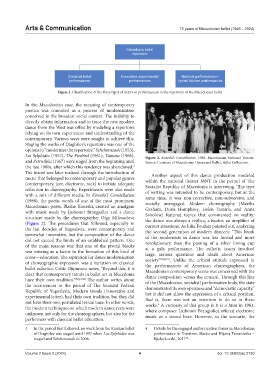
                          Figure 1. Classification of the three types of letters or performances in the repertoire of the Macedonian ballet

            In the Macedonian case, the meaning of contemporary
            poetics was connoted as a process of modernization
            conceived in the broadest social context. The inability to
            directly obtain information and to trace the new modern
            dance from the West was offset by modeling a repertoire
            relying on its own experiences and understanding of the
            contemporary. Various ways were sought to achieve this.
            Staging the works of Diaghilev’s repertoire was one of the
            options to “modernize the repertoire.” Scheherazade (1953),
            Les Sylphides (1957), Thе Firebird (1961), Tamara (1966),   Figure  2.  Koneski’s Constellation, 1988. Macedonian National Theatre.
            and Petrushka (1967) were staged from the beginning until   Source: Courtesy of Macedonian Opera and Ballet, Ballet Collection.
            the late 1960s, after which this tendency was abandoned. 3
            The intent was later realized through the introduction of   Another aspect of this dance production modeled
            music that belonged to contemporary and popular genres   within the national theater MNT in the period of The
            (contemporary, jazz, electronic, rock) to initiate adequate   Socialist Republic of Macedonia is interesting. This type
            reflection in choreography. Experiments were also made   of writing was intended to be contemporary, but at the
            with a mix of different media. In  Koneski’s Constellation   same time, it was non-corrective, non-subversive, and
            (1988), the poetic words of one of the most prominent   socially unengaged. Modern choreography (Martha
            Macedonian poets, Blazhe Koneski, created an amalgam   Graham,  Doris Humphrey, Helen Tamiris, and Anna
            with music made by Ljubomir Brangjolica and a dance   Sokolow) featured topics that commented on reality:
            structure made by the choreographer Olga Milosavleva   the dance was always a replica, a fixator, an amplifier of
            (Figure  2).  The  procedures  that  followed,  especially  in   current situations. As Julia Foulkes pointed out, analyzing
            the last decades of Yugoslavia, were contemporary and   the second generation of modern dancers: “This break
            somewhat innovative, but the composition of the dance   of the modernists in dance was less formal and more
            did not exceed the limits of an established pattern. One   revolutionary than the passing of a silver loving cup
            of the main reasons was that one of the pivotal blocks   at  a  gala  performance.  The  esthetic  issues  involved
            was missing as a factor in the formation of this kind of   large, serious  questions  and ideals  about  American
            scene—education. The aspiration for dance modernization   society” 21(p.15) .  Unlike  the  critical  attitude  expressed  in
            of choreographic expression was a variation on classical   the performances of American choreographers, the
            ballet esthetics. Critic Djipunova notes, “Beyond this, it is   Macedonian contemporary scene was concerned with the
            clear that contemporary trends in ballet art in Macedonia   dance composition versus the content. Through this line
            have their own tradition.” 20(p.144)  The author writes about   of the (Macedonian, socialist) performative body, the state
            the occurrences in the period of The Socialist Federal   demonstrated its own openness and “democratic capacity,”
            Republic of Yugoslavia. Modern trends (innovative and   but it did not allow the expression of a critical position,
            experimental letter), had their own tradition, but they did   that  is, there was not an intention to do so in these
            not have their own postulated lexical base. In other words,   works.  A curiosity of this group is It is a Man in 1981,
                                                                    4
            the modern techniques on which modern dance rests were   where composer Ljubomir Brangjolica offered electronic
            unknown not only for the choreographers, but also for the   music as a sound base. However, in the scenario, the
            performers with classical ballet education.
            3   In the period that followed, no work from the Russian ballet   4   Details for the engaged and recreation forms in Macedonian
               of Diaghilev was staged until 1997 when Les Sylphides was   performance in Dimitrov, Slavčo and Biljana Tanurovska –
               staged and Scheherazade in 2006.                   Kjulavkovski, 2017 .
                                                                                34

            Volume 2 Issue 2 (2024)                         4                                doi: 10.36922/ac.2730

