


Page 40 - AIH-1-1
P. 40
Artificial Intelligence in Health                            Digital and AI strategies for pharmaceutical industry


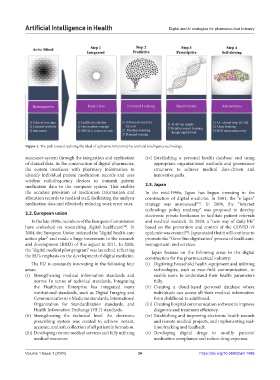
            Figure 1. The path toward realizing the ideal of a pharma 4.0 entirely by artificial intelligence technology.

            assurance system through the integration and application   (iv)  Establishing a personal health database and using
            of clinical data. In the construction of digital pharmacies,   appropriate organizational methods and governance
            the system interfaces with pharmacy information to    structures to achieve medical data-driven and
            identify individual patient medication records and uses   innovative goals.
            wireless radiofrequency devices to transmit patient
            medication data to the computer system. This enables   2.3. Japan
            the accurate provision of medication information and   In the mid-1990s, Japan has begun investing in the
            allocation records to medical staff, facilitating the analysis   construction of digital medicine. In 2001, the “e-Japan”
            medication data and effectively reducing work error rates.  strategy was announced . In 2008, the “internet
                                                                                    [15]
                                                               technology policy roadmap” was proposed to develop
            2.2. European union                                electronic private bookcases to facilitate patient referrals
              In the late 1990s, members of the European Commission   and medical research. In 2020, a “new way of daily life”
            have embarked on researching digital healthcare . In   based on the prevention and control of the COVID-19
                                                     [14]
            2004, the European Union initiated the “digital health-care   epidemic was created . Japan stated that it will continue to
                                                                                [16]
            action plan” and made a huge investment in the research   promote the “three-line digitization” process of healthcare,
            and development (R&D) of this aspect in 2011. In 2020,   management, and services.
            the “digital medical pilot program” was launched, reflecting   Japan focuses on the following areas in the digital
            the EU’s emphasis on the development of digital medicine.  construction for the pharmaceutical industry:
              The EU is constantly innovating in the following four   (i)  Digitizing household health equipment and utilizing
            areas:                                                technologies,  such  as  near-field  communication,  to
            (i)  Strengthening medical information  standards and   enable users to understand their health parameters
               norms: In terms of technical standards, Integrating   fully.
               the Healthcare Enterprise has integrated many   (ii)  Creating  a  cloud-based  personal  database  where
               institutional standards, such as Digital Imaging and   individuals can access all their medical information
               Communications in Medicine standards, International   from childhood to adulthood.
               Organization for  Standardization  standards,  and   (iii) Creating hospital communication software to improve
               Health Information Exchange (HL7) standards.       diagnosis and treatment efficiency.
            (ii)  Strengthening  the  technical  level:  An  electronic   (iv)  Establishing and improving electronic health records
               prescribing system was created to achieve instant,   and remote medical projects, and implementing real-
               accurate, and safe collection of all patient information.  time tracking and feedback.
            (iii) Developing remote medical services and fully utilizing   (v)  Developing digital drugs to modify patients’
               medical resources.                                 medication compliance and reduce drug expenses.


            Volume 1 Issue 1 (2024)                         34                        https://doi.org/10.36922/aih.1486

