


Page 125 - AIH-1-2
P. 125
Artificial Intelligence in Health                                              SDoH in clinical narratives


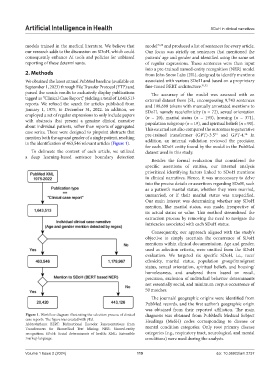
            models trained in the medical literature. We believe that   model 25,30  and produced a list of sentences for every article.
            our research adds to the discussion on SDoH, which could   Our focus was strictly on sentences that mentioned the
            consequently enhance AI tools and policies for unbiased   patients’ age and gender and identified using the same set
            reporting of these determinants.                   of regular expressions. These sentences were then input
                                                               into a pre-trained named-entity recognition (NER) model
            2. Methods                                         from John Snow Labs (JSL), designed to identify mentions
            We obtained the latest annual PubMed baseline (available on   associated with various SDoH and based on a proprietary
            September 1, 2023) through File Transfer Protocol (FTP) and   fine-tuned BERT architecture. 31,32
            parsed the search results to exclusively display publications   The accuracy of the model was assessed with an
            tagged as “Clinical Case Report,” yielding a total of 1,643,513   external dataset from JSL, encompassing 9,743 sentences
            reports. We refined the search for articles published from   and 198,698 tokens with manually annotated mentions to
            January 1, 1975, to December 31, 2022. In addition, we   SDoH, namely race/ethnicity (n = 72), sexual orientation
            employed a set of regular expressions to only include papers   (n = 20), marital status (n = 193), housing (n = 371),
            with abstracts that present a genuine clinical narrative   population subgroup (n = 19), and spiritual beliefs (n = 90).
            about individual patients, rather than reports of aggregated   This external test also compared the outcomes to generative
            case series. These were designed to pinpoint abstracts that   pre-trained transformer (GPT)-3.5  and GPT-4.  In
                                                                                                         34
                                                                                            33
            mention both the age and gender of a single patient, resulting   addition, an internal validation reviewed the precision
            in the identification of 463,546 relevant articles (Figure 1).
                                                               for each SDoH entity found by the model in the PubMed
              To delineate the content of each article, we utilized   dataset used in this study.
            a deep learning-based sentence boundary detection
                                                                 Besides the formal evaluation that considered the
                                                               specific  assertions  of entities, our  internal analysis
                                                               prioritized identifying factors linked to  SDoH mentions
                                                               in clinical narratives. Hence, it was unnecessary to delve
                                                               into the precise details or assertions regarding SDoH, such
                                                               as a patient’s marital status, whether they were married,
                                                               unmarried, or if their marital status was unspecified.
                                                               Our  main  interest  was  determining  whether  any  SDoH
                                                               mention,  like  marital  status,  was  made,  irrespective  of
                                                               its actual status or value. This method streamlined the
                                                               extraction process by removing the need to navigate the
                                                               intricacies associated with each SDoH status.
                                                                 Consequently, our approach aligned with the study’s
                                                               objective to simply ascertain the occurrence of SDoH
                                                               mentions within clinical documentation. Age and gender,
                                                               used as selection criteria, were omitted from the SDoH
                                                               evaluation.  We  targeted  six  specific  SDoH,  i.e.,  race/
                                                               ethnicity, marital status, population group/immigrant
                                                               status,  sexual  orientation, spiritual beliefs,  and  housing/
                                                               homelessness, and analyzed them based on recall,
                                                               precision, exclusion of individual behavior determinants
                                                               not essentially social, and minimum corpus occurrence of
                                                               50 matches.
                                                                 The journals’ geographic origins were identified from
                                                               PubMed records, and the first author’s geographic origin
                                                               was obtained from their reported affiliation. The main
            Figure 1. Workflow diagram illustrating the selection process of clinical   diagnosis was obtained from PubMed’s Medical Subject
            case reports. The figure was created with yEd.     Headings (MeSH) codes corresponding to disease or
            Abbreviations: BERT: Bidirectional Encoder Representations from
            Transformers for Biomedical Text Mining; NER: Named-entity   mental condition categories. Only root primary disease
            recognition; SDoH: Social determinants of health; XML: Extensible   categories (e.g., respiratory tract, neurological, and mental
            markup language.                                   conditions) were used during the analysis.


            Volume 1 Issue 2 (2024)                        119                               doi: 10.36922/aih.2737

