


Page 52 - AIH-2-1
P. 52
Artificial Intelligence in Health                       Asymmetric U-Net for enhanced spinal MRI segmentation


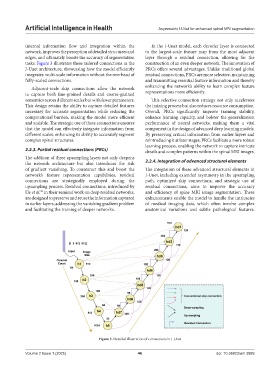
            internal information flow and integration within the   In the J-Unet model, each decoder layer is connected
            network, improves the perception of detailed structures and   to the largest-scale feature map from the most adjacent
            edges, and ultimately boosts the accuracy of segmentation   layer through a residual connection, allowing for the
            tasks. Figure 3 illustrates these tailored connections in the   construction of an even deeper network. The innovation of
            J-Unet architecture, showcasing how the model efficiently   PRCs offers several advantages. Unlike traditional global
            integrates multi-scale information without the overhead of   residual connections, PRCs are more selective, maintaining
            fully-scaled connections.                          and transmitting essential feature information and thereby

              Adjacent-scale skip connections allow the network   enhancing the network’s ability to learn complex feature
            to capture both fine-grained details and coarse-grained   representations more efficiently.
            semantics across different scales but with fewer parameters.   This selective connection strategy not only accelerates
            This design retains the ability to capture detailed features   the training process but also reduces resource consumption.
            necessary for accurate segmentation while reducing the   Overall, PRCs significantly improve training stability,
            computational burden, making the model more efficient   enhance learning capacity, and bolster the generalization
            and scalable. The strategic use of these connections ensures   performance of neural networks, making them a vital
            that the model can effectively integrate information from   component in the design of advanced deep learning models.
            different scales, enhancing its ability to accurately segment   By preserving critical information from earlier layers and
            complex spinal structures.                         reintroducing it at later stages, PRCs facilitate a more robust
                                                               learning process, enabling the network to capture intricate
            2.2.3. Partial residual connections (PRCs)         details and complex patterns within the spinal MRI images.
            The addition of three upsampling layers not only deepens
            the  network  architecture  but  also  introduces  the  risk   2.2.4. Integration of advanced structural elements
            of gradient vanishing. To counteract this and boost the   The integration of these advanced structural elements in
            network’s feature representation capabilities,  residual   J-Unet, including extended asymmetry in the upsampling
            connections are strategically employed during the   path, optimized skip connections, and strategic use of
            upsampling process. Residual connections, introduced by   residual connections, aims to improve the accuracy
            He et al.  in their seminal work on deep residual networks,   and efficiency of spine MRI image segmentation. These
                  30
            are designed to preserve and reuse the information captured   enhancements enable the model to handle the intricacies
            in earlier layers, addressing the vanishing gradient problem   of medical imaging data, which often involve complex
            and facilitating the training of deeper networks.  anatomical variations and subtle pathological features.


                                           Figure 3. Detailed illustration of connections in J-Unet


            Volume 2 Issue 1 (2025)                         46                               doi: 10.36922/aih.3889

