


Page 53 - AIH-2-1
P. 53
Artificial Intelligence in Health                       Asymmetric U-Net for enhanced spinal MRI segmentation


            By effectively managing these complexities, the J-Unet   prominent architectures in the field, thereby providing a
            architecture supports more precise diagnostic outcomes   clear perspective on the current state of the art in spinal
            and potentially informs better clinical decision-making.  MR image segmentation.
              Accurate segmentation of spine MRI images can aid   3.1. Experimental setup
            in the early detection and diagnosis of spinal pathologies
            such as disc herniation, spinal stenosis, and tumors. Precise   We utilized three evaluation metrics to assess the
            delineation of these structures is essential for planning   segmentation performance of our models: accuracy, mean
            surgical interventions, assessing disease progression, and   intersection over union (mIOU), and dice coefficient.
            evaluating treatment efficacy. The improved segmentation   These metrics provide a comprehensive view of the model’s
            performance offered by the J-Unet model can therefore   effectiveness in segmenting vertebrae and intervertebral
            contribute to better patient outcomes by enabling more   discs in spinal MR images. The formulas for these metrics
            targeted and effective treatments.                 are as follows:
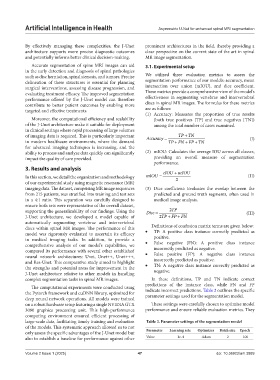
                                                               (1)  Accuracy: Measures the proportion of true results
              Moreover, the computational efficiency and scalability   (both true positives [TP] and true negatives [TN])
            of the J-Unet architecture make it suitable for deployment   among the total number of cases examined.
            in clinical settings where rapid processing of large volumes
            of imaging data is required. This is particularly important   Accuracy  =  TP +TN              (I)
            in modern healthcare environments, where the demand            +TP  +FN  + FP TN
            for  advanced  imaging  techniques  is  increasing,  and  the
            ability to process and analyze data quickly can significantly   (2)  mIOU: Calculates the average IOU across all classes,
            impact the quality of care provided.                  providing an overall measure of segmentation
                                                                  performance.
            3. Results and analysis                                   cIOU  + ucIOU
            In this section, we detail the organization and methodology   mIOU  =  2                       (II)
            of our experimental study using magnetic resonance (MR)
            imaging data. The dataset, comprising MR image sequences   (3)  Dice coefficient: Evaluates the overlap between the
            from 215 patients, was stratified into training and test sets   predicted and ground truth segments, often used in
            in a 4:1 ratio. This separation was carefully designed to   medical image analysis.
            ensure both sets were representative of the overall dataset,
            supporting the generalizability of our findings. Using the   Dice =  2TP                      (III)
                                                                             +
            J-Unet architecture, we developed a model capable of        + 2TP FP FN
            automatically segmenting vertebrae and intervertebral
            discs within spinal MR images. The performance of this   Definitions of confusion matrix terms are given below:
            model was rigorously evaluated to ascertain its efficacy   •   TP: A positive class instance correctly predicted as
            in medical imaging tasks. In addition, to provide a   positive.
            comprehensive analysis of our model’s capabilities, we   •   False  negative  (FN):  A  positive  class  instance
            compared its performance with several other established   •   incorrectly predicted as negative.
                                                                  False  positive (FP):  A  negative  class  instance
            neural network architectures: Unet, Unet++, Unet+++,   incorrectly predicted as positive.
            and Res-Unet. This comparative study aimed to highlight   •   TN: A negative class instance correctly predicted as
            the strengths and potential areas for improvement in the   negative.
            J-Unet architecture relative to other models in handling
            complex segmentation tasks in spinal MR images.      In these definitions, TP and TN indicate  correct
                                                               predictions of the instance class, while FN and FP
              The computational experiments were conducted using
            the Pytorch framework and cuDNN library, optimized for   indicate incorrect predictions. Table 2 outlines the specific
                                                               parameter settings used for the segmentation model.
            deep neural network operations. All models were trained
            on a robust hardware setup featuring a single NVIDIA GTX   These settings were carefully chosen to optimize model
            3090  graphics processing unit. This high-performance   performance and ensure reliable evaluation metrics. They
            computing environment ensured efficient processing of
            large-scale data, facilitating timely training and evaluation   Table 2. Parameter settings of the segmentation model
            of the models. This systematic approach allowed us to not   Parameter  Learning rate  Optimizer  Batch size  Epoch
            only assess the specific advantages of the J-Unet model but
            also to establish a baseline for performance against other   Value  1e-4   Adam       2     100


            Volume 2 Issue 1 (2025)                         47                               doi: 10.36922/aih.3889

