


Page 55 - AIH-2-1
P. 55
Artificial Intelligence in Health                       Asymmetric U-Net for enhanced spinal MRI segmentation


                         A                                   B


                         C                                   D


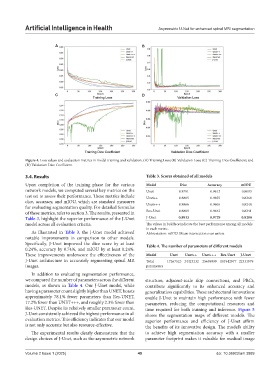
            Figure 4. Loss values and evaluation metrics in model training and validation. (A) Training Loss; (B) Validation Loss; (C) Training Dice Coefficient; and
            (D) Validation Dice Coefficient

            3.4. Results                                       Table 3. Scores obtained of all models
            Upon completion of the training phase for the various   Model    Dice        Accuracy       mIOU
            network models, we computed several key metrics on the   Unet    0.8791       0.9613        0.8093
            test set to assess their performance. These metrics include   Unet++  0.8885  0.9655        0.8264
            dice, accuracy, and mIOU, which are standard measures   Unet+++  0.8866       0.9606        0.8248
            for evaluating segmentation quality. For detailed formulas
            of these metrics, refer to section 3. The results, presented in   Res-Unet  0.8889  0.9642  0.8241
            Table 3, highlight the superior performance of the J-Unet   J-Unet  0.8913    0.9729        0.8288
            model across all evaluation criteria.              The values in boldface indicate the best performance among all models
                                                               in each metric.
              As illustrated in  Table 3, the J-Unet model achieved   Abbreviation: mIOU: Mean intersection over union.
            notable improvements in comparison to other models.
            Specifically, J-Unet improved the dice score by at least   Table 4. The number of parameters of different models
            0.24%, accuracy by 0.74%, and mIOU by at least 0.24%.
            These improvements underscore the effectiveness of the   Model  Unet  Unet++  Unet+++  Res‑Unet  J‑Unet
            J-Unet architecture in accurately segmenting spinal MR   Total   17267523 24423232 25659999 101942977 22331979
            images.                                            parameters
              In addition to evaluating segmentation performance,
            we compared the number of parameters across the different   structure, adjacent-scale skip connections, and PRCs,
            models, as shown in  Table 4. Our J-Unet model, while   contribute significantly to  its  enhanced accuracy  and
            having a parameter count slightly higher than UNET, boasts   generalization capabilities. These architectural innovations
            approximately 78.1% fewer parameters than Res-UNET,   enable  J-Unet  to  maintain  high  performance  with  fewer
            17.2% fewer than UNET+++, and roughly 2.3% fewer than   parameters, reducing the computational resources and
            Res-UNET. Despite its relatively smaller parameter count,   time required for both training and inference.  Figure  5
            J-Unet consistently achieved the highest performance in all   shows the segmentation maps of different models. The
            evaluation metrics. This efficiency indicates that our model   superior performance and efficiency of J-Unet affirm
            is not only accurate but also resource-effective.  the  benefits  of  its innovative design. The  model’s  ability
              The experimental results clearly demonstrate that the   to achieve high segmentation accuracy with a smaller
            design choices of J-Unet, such as the asymmetric network   parameter footprint makes it valuable for medical image


            Volume 2 Issue 1 (2025)                         49                               doi: 10.36922/aih.3889

