


Page 78 - AIH-2-1
P. 78
Artificial Intelligence in Health                                       ViT for Glioma Classification in MRI


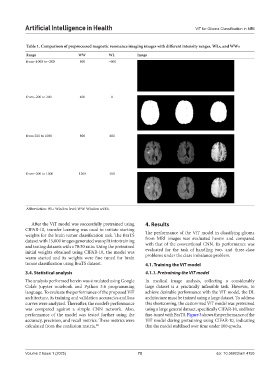
            Table 1. Comparison of preprocessed magnetic resonance imaging images with different intensity ranges, WLs, and WWs
            Range                 WW           WL          Image
            from−1000 to−200       800         −600


            from−200 to 200        400          0


            from 200 to 1000       800          600


            from−200 to 1000       1200         400


            Abbreviation: WL: Window level; WW: Window width.


              After the ViT model was successfully pretrained using   4. Results
            CIFAR-10, transfer learning was used to initiate starting
            weights for the brain tumor classification task. The BraTS   The performance of the ViT model in classifying glioma
            dataset with 15,000 images generated was split into training   from  MRI  images  was  evaluated  herein  and  compared
            and testing datasets with a 70:30 ratio. Using the pretrained   with that of the conventional CNN. Its performance was
            initial weights obtained using CIFAR-10, the model was   evaluated for the task of handling two-  and three-class
            warm started and its weights were fine tuned for brain   problems under the class imbalance problem.
            tumor classification using BraTS dataset.          4.1. Training the ViT model

            3.4. Statistical analysis                          4.1.1. Pretraining the ViT model
            The analysis performed herein was simulated using Google   In medical image analysis, collecting a considerably
            Colab Jupyter notebook and Python 3.6 programming   large dataset is a practically infeasible task. However, to
            language. To evaluate the performance of the proposed ViT   achieve desirable performance with the ViT model, the DL
            architecture, its training and validation accuracies and loss   architecture must be trained using a large dataset. To address
            curves were analyzed. Thereafter, the model’s performance   this shortcoming, the customized ViT model was pretrained
            was  compared  against  a  simple  CNN  network.  Also,   using a large general dataset, specifically CIFAR-10, and later
            performance of  the  model was  tested  further  using the   fine-tuned with BraTS. Figure 3 shows the performance of the
            accuracy, precision, and recall metrics. These metrics were   ViT model during pretraining using CIFAR-10, indicating
            calculated from the confusion matrix. 28           that the model stabilized over time under 100 epochs.


            Volume 2 Issue 1 (2025)                         72                               doi: 10.36922/aih.4155

