


Page 83 - AIH-2-1
P. 83
Artificial Intelligence in Health                                       ViT for Glioma Classification in MRI


                         A                                   B


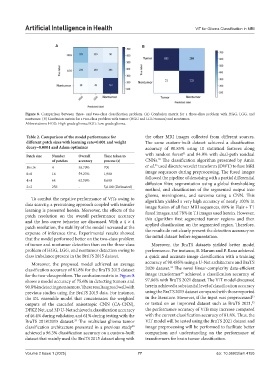
            Figure  8.  Comparison between three-  and two-class classification problem. (A) Confusion matrix for a three-class problem with HGG, LGG, and
            nontumor. (B) Confusion matrix for a two-class problem with tumor (HGG and LGG tumors) and nontumor.
            Abbreviations: HGG: High-grade glioma; LGG: Low-grade glioma.


            Table 2. Comparison of the model performance for   the other MRI images collected from different sources.
            different patch sizes with learning rate=0.001 and weight   The same custom-built dataset achieved a classification
            decay=0.0001 and Adam optimizer                    accuracy of 80.85% using 10 statistical features along
                                                                               31
            Patch size  Number    Overall    Time taken to     with random forest  and 84.9% with dual-path residual
                                                                    32
                       of patches  accuracy  process (s)       CNNs.  The classification algorithm presented by Amin
                                                                   33
            16×16      4          56.70%     700               et  al.  used discrete wavelet transform (DWT) to fuse MRI
            8×8        16         59.23%     1,900             image sequences during preprocessing. The fused images
            4×4        64         62.56%     8,600             followed the pipeline of denoising with a partial differential
                                                               diffusion filter, segmentation using a global thresholding
            2×2        256        -          5,6100 (Estimated)
                                                               method, and classification of the segmented output into
                                                               glioma,  meningioma,  and  sarcoma  using  a  CNN.  This
              To combat the negative performance of ViTs owing to   algorithm yielded a very high accuracy of nearly 100% in
            data scarcity, a pretraining approach coupled with transfer   image fusion of all four MRI sequences, 89% in Flair + T1
            learning is presented herein. Moreover, the effects of the   fused images, and 78% in T1 images used herein. However,
            patch resolution on the overall performance accuracy   this  algorithm  first  segmented  tumor  regions  and  then
            and the loss curve behavior are discussed. With a 4 × 4
            patch resolution, the stability of the model increased at the   applied classification on the segmented region. Therefore,
            expense of  inference  time. Experimental results showed   the results do not clearly present the detection accuracy on
            that the model performed better on the two-class problem   the initial dataset before segmentation.
            of tumor and nontumor detection than on the three-class   Moreover, the BraTS datasets yielded better model
            problem of HGG, LGG, and nontumor detection owing to   performance. For instance, B. Maram and P. Rana achieved
            class imbalance present in the BraTS 2015 dataset.  a quick and accurate image classification with a training
              Moreover, the proposed model achieved an average   accuracy of 98.485% using a U-Net architecture and BraTS
                                                                         34
            classification accuracy of 81.8% for the BraTS 2015 dataset   2020 dataset.  The novel linear-complexity data-efficient
                                                                              35
            for the two-class problem. The confusion matrix in Figure 8   image transformer  achieved a classification accuracy of
            shows a model accuracy of 75.6% in detecting tumors and   97.86% with BraTS 2021 dataset. The ViT model discussed
            90.8% in detecting nontumors. These results agreed well with   herein achieved a substantial level of classification accuracy
            previous studies using the BraTS 2015 data. For instance,   using the BraTS 2015 dataset compared with those reported
                                                                                                            33
            the DL ensemble model that concatenates the weighted   in the literature. However, if the input was preprocessed
                                                                                                            35
            outputs of the cascaded anisotropic CNN (CA-CNN),   or tested on an improved dataset such as BraTS 2021,
            DFKZ Net, and 3D U-Net achieved a classification accuracy   the performance accuracy of ViTs may increase compared
            of 46.4% during validation and 61% during testing with the   with the current classification accuracy of 81.8%. Thus, the
            BraTS 2018/2015 dataset.  The multiclass glioma tumor   ViT model will be tested using the BraTS 2021 dataset and
                                 29
            classification architecture presented in a previous study    image preprocessing will be performed to facilitate better
                                                         30
            achieved a 96.3% classification accuracy on a custom-built   comparison and understanding on the performance of
            dataset that mainly used the BraTS 2015 dataset along with   transformers for brain tumor classification.


            Volume 2 Issue 1 (2025)                         77                               doi: 10.36922/aih.4155

