


Page 92 - AIH-2-1
P. 92
Artificial Intelligence in Health                          Benchmarking ML imputation in mental health surveys


            rates. Around 39% of male participants have high missing   identified as “Multiple Races” have low missing rates. The
            rates, which is slightly larger than the 37% of female   rates of missingness for self-reported African American,
            participants, while 33.5% of male participants have low   Asian, and Native American individuals are concentrated
            missing rates, and only around 28% of female participants   toward the extreme values, with more than 30% exhibiting
            have low missing rates.                            high missing rates, while <25% of the participants who
                                                               were self-identified as White or “Multiple Races” reported
              For individuals between ages 2 and 18, around 22% of   high missing rates. Those who self-reported themselves as
            these participants have medium missing rates. The missing   an “Other” race exhibit large amounts of missingness since
            rates of these individuals are more concentrated toward   around 66% have missing rates larger than 80%.
            extreme values since around 39% have either low or high
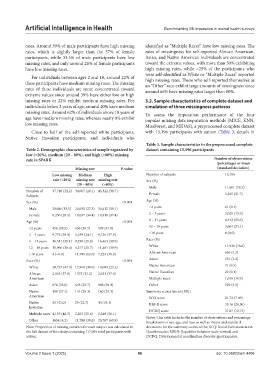
            missing rates or 22% exhibit medium missing rates. For   3.2. Sample characteristics of complete dataset and
            individuals below 2 years of age, around 40% have medium   simulation of three missingness patterns
            missing rates. Around 62% of individuals above 18 years of   To assess the imputation performance of the four
            age have medium missing rates, whereas nearly 0% exhibit   popular missing data imputation methods (MICE, KNN,
            low missing rates.                                 MissForest, and MIDAS), a preprocessed complete dataset
              Close to half of the self-reported white participants,   with 15,196 participants with autism (Table 3, details in
            Native Hawaiian participants, and individuals who
                                                               Table 3. Sample characteristics in the preprocessed complete
            Table 2. Demographic characteristics of sample organized by   dataset containing 15,196 participants
            low (<20%), medium (20 – 80%), and high (>80%) missing
            rate in SPARK                                                                   Number of observations
                                                                                             (percentage) or mean
                                 Missing rate       P‑value                                  (standard deviation)
                       Low missing   Medium   High             Number of subjects                15,196
                        rate (<20%)  missing rate  missing rate   Sex (%)
                                  (20 – 80%)  (>80%)
            Number of   37,710 (32.2) 34,067 (29.1) 45,322 (38.7)     Male                       11,901 (78.3)
            Subjects                                            Female                           3,295 (21.7)
            Sex (%)                                  <0.001    Age (%)
             Male      29460 (33.5)  24,030 (27.3) 34,412 (39.1)  <2 years                       61 (0.4)
             Female    8,250 (28.3)  10,037 (34.4) 10,910 (37.4)  2 – 5 years                    3,029 (19.9)
            Age (%)                                  <0.001     6 – 11 years                     8,442 (55.6)
             <2 years  456 (28.5)  636 (39.7)  509 (31.8)       12 – 18 years                    3,664 (24.1)
             2 – 5 years  9,773 (38.0)  6,189 (24.1)  9,726 (37.9)  >18 years                    0 (0.0)
             6 – 11 years  16,511 (39.1) 9,230 (21.9)  16,463 (39.0)  Race (%)
             12 – 18 years  10,966 (38.4) 6,217 (21.7)  11,401 (39.9)  White                     11,938 (78.6)
             >18 years  4 (~0.0)  11,795 (62.0) 7,223 (38.0)    African American                 656 (4.3)
            Race (%)                                 <0.001     Asian                            331 (2.2)
             White     28,727 (47.3) 17,968 (30.0) 14,093 (23.2)  Native American                71 (0.5)
             African   2,063 (37.8)  1373 (25.2)  2,021 (37.0)  Native Hawaiian                  22 (0.1)
             American                                           Multiple races                   1,649 (10.9)
             Asian     876 (35.0)  645 (25.7)  988 (39.4)       Other                            529 (3.5)
             Native    180 (37.4)  141 (29.3)  160 (33.3)      Summary scores (mean [SD])
             American                                           SCQ score                        21.72 (7.09)
             Native    55 (43.0)  29 (22.7)  44 (34.4)          RBS-R score                      35.16 (20.50)
             hawaiian
                                                                DCDQ score                       37.87 (12.73)
             Multiple races 4,155 (48.3)  2,203 (25.6)  2,249 (26.1)
                                                               Notes: This table includes the number of observations and percentage
             Other     1654 (4.2)  11,708 (30.0) 25,767 (65.9)  breakdowns of sex, age, and race as well as means and standard
            Note: Proportion of missing variables for each subject was calculated in   deviations for the summary scores of the; SCQ: Social Communication
            the full dataset of this study containing 117,099 total participants with   Questionnaire; RBS-R: Repetitive behavior scale-revised; and
            autism.                                            DCDQ: Developmental coordination disorder questionnaire.


            Volume 2 Issue 1 (2025)                         86                               doi: 10.36922/aih.4406

