


Page 96 - AIH-2-1
P. 96
Artificial Intelligence in Health                          Benchmarking ML imputation in mental health surveys


                                                               and accurate. This shows that when a block of correlated
                                                               variables in one survey is completely missing, other related
                                                               surveys or medical history can also provide relevant
                                                               information for imputation. The choice of imputation
                                                               methods may depend on the overall missing rate and
                                                               missingness patterns in a dataset.
                                                                 The strength of our study is that a large-scale collection
                                                               of mental and behavioral surveys in SPARK was utilized
                                                               to simulate the missingness patterns, particularly with
                                                               blockwise missing structures that are commonly observed
                                                               in mental health databases. This study also systematically
                                                               assessed the latest missing data imputation approaches
                                                               like MIDAS. The limitation is that the complete data with
                                                               missing data simulation primarily comes from adolescents.
                                                               Despite the inclusion of various racial groups in the
                                                               simulation, most participants are white. Assessment in
                                                               other types of large-scale mental and behavioral surveys
                                                               with adults and minority groups is warranted for future
                                                               studies.
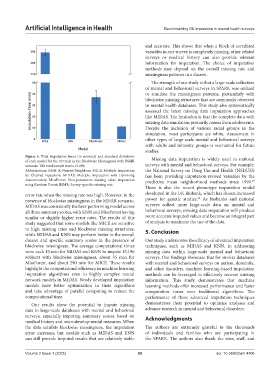
            Figure 5. Total imputation times (in minutes) and standard deviations   Missing data imputation is widely used in national
            of each model for the 10 trials in the Blockwise Missingness with BSMR
            scenario. The total sample size is 15,196.         surveys with mental and behavioral surveys. For example,
            Abbreviations: KNN: K-Nearest Neighbors; MICE: Multiple Imputation   the National Survey on Drug Use and Health (NSDUH)
            by Chained Equations; MIDAS: Multiple Imputation with Denoising   has been providing imputation-revised variables by the
            Autoencoders; MissForest: Non-parametric missing value imputation   predictive mean neighborhood methods since 1999.
                                                                                                            29
            using Random Forest; BSMR: Survey-specific missing rate.
                                                               There is also the recent phenotype imputation model
            error rate when the missing rate was high. However, in the   developed in the UK Biobank, which has shown increased
                                                                                     30
            presence of blockwise missingness in the MNAR scenario,   power for genetic studies.  As biobanks and national
            MIDAS was consistently the best-performing model across   surveys collect more large-scale data on mental and
            all three summary scores, with KNN and MissForest having   behavioral surveys, missing data imputation will produce
            similar or slightly higher error rates. The  results of this   more accurate imputed values and become an integral part
            study suggested that some models like MICE are sensitive   of analysis to maximize the use of the data.
            to high missing rates and blockwise missing structures,   5. Conclusion
            while MIDAS and KNN may perform better in the overall
            dataset and specific summary scores in the presence of   Our study underscores the efficacy of advanced imputation
            blockwise missingness. The average computational times   techniques, such as MIDAS and KNN, in addressing
            were each 10 min for MIDAS and KNN to impute 15,196   missing  data  within large-scale mental and  behavioral
            subjects  with  blockwise  missingness,  about  35  min  for   surveys. Our findings showcase that for similar databases
            MissForest, and about 290  min for MICE. These results   with mental and behavioral surveys on autism, dementia,
            highlight the computational efficiency in machine learning   and other disorders, machine learning-based imputation
            imputation algorithms even in highly complex neural   methods can be leveraged to effectively recover missing
            network models in MIDAS. Newly developed imputation   information.  This  study  demonstrates  that  machine
            models have better optimization in their algorithms   learning methods offer increased performance and faster
            and take advantage of parallel computing to reduce the   computation times over traditional algorithms. The
            computational time.                                performance of these advanced imputation techniques
              Our results show the potential to impute missing   demonstrates their potential to optimize analyses and
            data in large-scale databases with mental and behavioral   advance research in mental and behavioral disorders.
            surveys,  especially  imputing  summary scores based on   Acknowledgments
            medical history and neurodevelopmental measures. When
            the data exhibits blockwise missingness, the imputation   The authors are extremely grateful to the thousands
            error  increases,  but  models  such  as  MIDAS  and KNN   of individuals and families who are participating in
            can still provide imputed results that are relatively stable   the SPARK. The authors also thank the sites, staff, and


            Volume 2 Issue 1 (2025)                         90                               doi: 10.36922/aih.4406

