


Page 136 - AIH-2-3
P. 136
Artificial Intelligence in Health                                   Early detection of CIN/cervicitis using ML


                         A                   B                         C


                         D


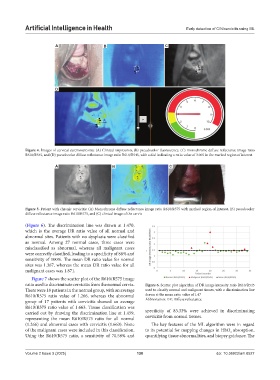
            Figure 4. Images of cervical carcinosarcoma: (A) Clinical impression, (B) pseudocolor fluorescence, (C) monochrome diffuse reflectance image ratio
            R610/R545, and (D) pseudocolor diffuse reflectance image ratio R610/R545, with a dial indicating a ratio value of 3.005 in the marked region of interest


                         A                       B                       C


            Figure 5. Patient with chronic cervicitis: (A) Monochrome diffuse reflectance image ratio R610/R575 with marked region of interest, (B) pseudocolor
            diffuse reflectance image ratio R610/R575, and (C) clinical image of the cervix

            (Figure  6). The discrimination line was drawn at 1.470,
            which  is  the  average  DR  ratio  value  of  all  normal  and
            abnormal sites. Patients with no dysplasia were classified
            as normal. Among 27 normal cases, three cases were
            misclassified as abnormal, whereas all malignant cases
            were correctly classified, leading to a specificity of 88% and
            sensitivity of 100%. The mean DR ratio value for normal
            sites was 1.367, whereas the mean DR ratio value for all
            malignant cases was 1.871.
              Figure 7 shows the scatter plot of the R610/R575 image
            ratio used to discriminate cervicitis from the normal cervix.   Figure 6. Scatter plot algorithm of DR image intensity ratio R610/R545
            There were 18 patients in the normal group, with an average   used to classify normal and malignant tissues, with a discrimination line
            R610/R575  ratio  value  of  1.266,  whereas  the  abnormal   drawn at the mean ratio value of 1.47
            group of 17  patients with cervicitis showed an average   Abbreviation: DR: Diffuse reflectance.
            R610/R575 ratio value of 1.663. Tissue classification was
            carried out by drawing the discrimination line at 1.459,   specificity of 83.33% were achieved in discriminating
            representing the mean R610/R575 ratio for all normal   cervicitis from normal tissues.
            (1.266) and abnormal cases with cervicitis (1.663). None   The key features of the ML algorithm were in regard
            of the malignant cases were included in this classification.   to its potential for mapping changes in HbO  absorption,
                                                                                                   2
            Using the R610/R575 ratio, a sensitivity of 70.58% and   quantifying tissue abnormalities, and biopsy guidance. The


            Volume 2 Issue 3 (2025)                        130                               doi: 10.36922/aih.8527

