


Page 133 - AIH-2-3
P. 133
Artificial Intelligence in Health                                   Early detection of CIN/cervicitis using ML


            gingiva using the R620/R575 image intensity ratio. In   cervicitis,  respectively. The  study  conducted using  this
            another study, the R620/R575 spectral ratio was able to   device demonstrates its potential for real-time tissue status
            discriminate between healthy gingiva from gingivitis, with   assessment and its ability to detect the most malignant site
            90% sensitivity and 94% specificity, whereas a sensitivity   for biopsy. The DR image ratios were correlated with the
            of 91% and a specificity of 100% were obtained when   histopathology results of guided biopsies to develop an ML
            discriminating gingivitis from periodontitis.  Recently,   algorithm. The diagnostic accuracy of the screening was
                                                 18
            Barik  et al.  recorded the fluorescence emission of the   determined from the scatter plot diagrams, and the results
                     19
            cervix on excitation at 325 nm, and the spectral features   were presented accordingly.
            were  used  to discriminate  dysplasia  from  inflammatory
            changes. An increase in fluorescence emission intensity   2. Materials and methods
            in cervicitis samples was observed at 435 nm compared   2.1. Methodology
            to normal tissue, which was attributed to the fluorophore
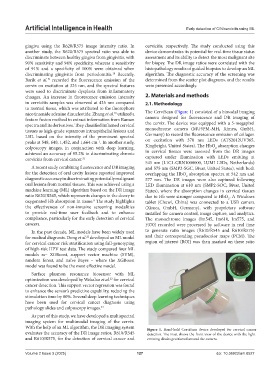
            nicotinamide adenine dinucleotide. Zhang et al.  utilized a   The CerviScan (Figure 1) consisted of a bimodal imaging
                                                  20
            feature fusion method to extract information from Raman   camera  designed  for  fluorescence  and  DR  imaging  of
            spectra and its derivatives. They classified inflamed cervical   the cervix. The device was equipped with a 5-megapixel
            tissues as high-grade squamous intraepithelial lesions and   monochrome camera (MU9PM-MH, Ximea, GmbH,
            LSIL based on the intensity of the prominent spectral   Germany) to record the fluorescence emission of collagen
                                          −1
            peaks at 548, 640, 1,452, and 1,664 cm . In another study,   on excitation with 370  nm LEDs (ATS2012UV365,
            colposcopy images,  in  conjunction  with deep learning,   Kingbright, United States). The HbO  absorption changes
                                                                                             2
            achieved an accuracy of 95.2% in discriminating chronic   in cervical tissues were assessed from the DR images
            cervicitis from cervical cancer. 21                captured under illumination with LEDs emitting at
                                                               545 nm (L1C1-GRN1000000, LUMI LEDs, Netherlands)
              A recent study combining fluorescence and DR imaging   and 575 nm (SMP2-SGC, Bivar, United States), with both
            for the detection of oral cavity lesions reported improved   overlapping the HbO  absorption spectra at 542 nm and
                                                                                2
            diagnostic accuracy in discriminating potentially malignant   577  nm. The DR images were also captured following
            oral lesions from normal tissues. This was achieved using a   LED illumination at 610 nm (SMP2-SOC, Bivar, United
            machine learning (ML) algorithm based on the DR image   States), where the absorption changes in cervical tissues
            ratio R620/R545, which represents changes in the deoxy to   due to Hb were stronger compared to HbO . A Windows
                                                                                                  2
            oxygenated Hb absorption in tissue.  The study highlights   tablet  (Chuwi,  China)  was  connected to  a  USB  camera
                                         8
            the effectiveness of non-invasive screening modalities   (Ximea,  GmbH,  Germany),  with  proprietary  software
            to  provide  real-time  user  feedback  and  to  enhance   installed for camera control, image capture, and analytics.
            compliance, particularly for the early detection of cervical   The monochrome images (Im545, Im610, Im575, and
            cancers.                                           F370) recorded were processed by software in real time
              In the past decade, ML models have been widely used   to generate ratio images (R610/R545 and R610/R575)
            for medical diagnosis. Dong et al.  developed an ML model   and their corresponding pseudocolor maps (PCM). The
                                      22
            for cervical cancer risk stratification using full-genotyping   region of interest (ROI) was then marked on these ratio
            of high-risk HPV test data. The study compared four ML
            models zs– XGBoost, support vector machine (SVM),
            random forest, and naïve Bayes – where the XGBoost
            model was found to be the most effective model.
              Surface  plasmon  resonance  biosensor  with  ML
            optimization was developed by Wekalao et al.  for cervical
                                                23
            cancer detection. This support vector regression was found
            to enhance the sensor’s predictive capability, reducing the
            stimulation time by 80%. Several deep learning techniques
            have been used for cervical cancer diagnosis using
            pathology slides and colposcopy images. 24
              As part of this study, we have developed a multispectral
            imaging  system  for  multimodal  imaging  of  the  cervix.
            With the help of an ML algorithm, the DR imaging system   Figure  1.  Hand-held CerviScan  device developed  for cervical  cancer
            evaluates the accuracy of the DR image ratios, R610/R545   detection. The inset shows the front view of the device with the light-
            and R610/R575, for the detection of cervical cancer and   emitting diodes positioned around the camera.


            Volume 2 Issue 3 (2025)                        127                               doi: 10.36922/aih.8527

