


Page 163 - AIH-2-3
P. 163
Artificial Intelligence in Health                                   EI and AI among healthcare professionals


              Evidence from the existing literature shows that both   blob/main/main.py – that visualizes the key terms and
            EI and AI contribute to the PD of healthcare professionals.   concepts emerging from the reviewed studies. This
            By fostering emotional competence alongside technical   visualization  highlights  the  frequency  and  significance
            expertise, healthcare systems can improve the quality of   of the central themes, offering a concise overview of the
            patient care and support healthcare professionals’ well-  critical  ideas  surrounding  EI  and  AI  in  the  context  of
            being. This dual focus is essential for addressing the   healthcare professionals. It provides a clear illustration of
            evolving challenges within the healthcare sector.  the dominant themes and their relationships as identified
              This study identified several key studies that met the   in the research literature.
            inclusion criteria, highlighting the significance of EI and   4. Discussion
            AI in the PD of healthcare professionals. High EI was
            associated with  improved communication,  enhanced   4.1. Implications of EI and AI on the PD of healthcare
            patient satisfaction, and reduced burnout. On the other   professionals
            hand, AI contributed to personalized learning tools,   The integration of EI and AI in the PD of healthcare
            improved diagnostic accuracy, and supported decision-  professionals presents a valuable avenue for PD. Integrating
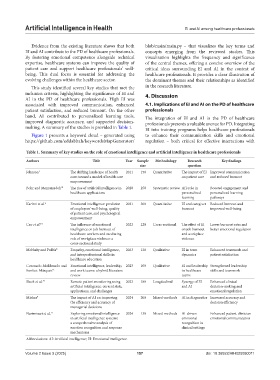
            making. A summary of the studies is provided in Table 1.  EI into training programs helps healthcare professionals
              Figure 1 presents a keyword cloud – generated using   to enhance their communication skills and emotional
            https://github.com/eddabbah/keywordsMapGenerator/  regulation – both critical for effective interactions with

            Table 1. Summary of key studies on the role of emotional intelligence and artificial intelligence in healthcare professionals
            Authors                     Title         Year  Sample   Methodology  Research     Key findings
                                                             size                question
            Johnson 1          The shifting landscape of health   2011  150  Quantitative  The impact of EI  Improved communication
                               care: toward a model of health care            on patient care  and reduced burnout
                               empowerment
            Bohr and Memarzadeh 10  The rise of artificial intelligence in  2020  250  Systematic review AI’s role in   Boosted engagement and
                               healthcare applications                        personalized   personalized learning
                                                                              learning    pathways
            Karimi et al. 6    Emotional intelligence: predictor   2021  300  Quantitative  EI and caregiver  Reduced burnout and
                               of employees’ well-being, quality              burnout     improved well-being
                               of patient care, and psychological
                               empowerment
            Cao et al. 14      The influence of emotional   2022  220  Cross-sectional  The effect of EI   Lower burnout rates and
                               intelligence on job burnout of                 on job burnout   better emotional regulation
                               healthcare workers and mediating               and workplace
                               role of workplace violence: a                  violence
                               cross-sectional study
            McNulty and Politis 5  Empathy, emotional intelligence,   2023  120  Qualitative  EI in team   Enhanced teamwork and
                               and interprofessional skills in                dynamics    patient satisfaction
                               healthcare education
            Coronado-Maldonado and  Emotional intelligence, leadership,  2023  100  Qualitative  EI and leadership  Strengthened leadership
            Benítez-Márquez 12  and work teams: a hybrid literature           in healthcare   skills and teamwork
                               review                                         teams
            Shaik et al. 19    Remote patient monitoring using   2023  180  Longitudinal  Synergy of EI   Enhanced clinical
                               artificial intelligence: current state,        and AI      decision-making and
                               applications, and challenges                               emotional regulation
            Mishra 7           The impact of AI on improving   2024  200  Mixed-methods  AI in diagnostics Increased accuracy and
                               the efficiency and accuracy of                             decision efficiency
                               managerial decisions
            Narimisaei et al. 11  Exploring emotional intelligence   2024  130  Mixed-methods  AI-driven   Enhanced patient-clinician
                               in artificial intelligence systems:            emotional   emotional communication
                               a comprehensive analysis of                    recognition in
                               emotion recognition and response               clinical settings
                               mechanisms
            Abbreviations: AI: Artificial intelligence; EI: Emotional intelligence.


            Volume 2 Issue 3 (2025)                        157                           doi: 10.36922/AIH025080011

