


Page 136 - AIH-2-4
P. 136
Artificial Intelligence in Health                                 Artificial intelligence app for EVD navigation


            1. Introduction                                    divert cerebrospinal fluid (CSF) for both therapeutic
                                                               and diagnostic purposes. It is most commonly used to
            Surgical navigation has become a crucial tool in neurosurgery,   manage elevated intracranial pressure in conditions such
            enabling accurate localization and targeting of lesions   as subarachnoid hemorrhage, traumatic brain injury, and
            within the brain and spine to improve surgical precision and   hydrocephalus.  EVDs allow continuous monitoring of
                                                                           41
                          1-3
            patient outcomes.  While traditional navigation methods   intracranial pressure and facilitate sampling of CSF to
            relied on intraoperative imaging, computer-assisted   guide treatment of structural obstructions, hemorrhage-
            navigation systems have become increasingly common and   related complications, and other conditions. 42
                  4-7
            popular.  These systems, however, typically require costly,
            proprietary computing to run navigation software and are   The placement procedures involve incising the scalp
            often bulky and cumbersome.                        and drilling a small burr hole, typically at Kocher’s point—
                                                               approximately 10–11 cm posterior to the nasion and 2–3 cm
              Innovations in computation, particularly artificial   lateral to the midline—followed by careful advancement of
            intelligence (AI), have paved the way for the development   a catheter 6–7 cm until CSF return is noted. This location
            of higher-accuracy, lower-cost navigation techniques.   is presumed to be in the ipsilateral lateral ventricle near the
            Convolutional neural networks (CNNs), in particular,   foramen of Monro, which connects the lateral ventricles to
            have revolutionized image recognition across industries,   the inferior third ventricle.  The catheter is then tunneled
                                                                                    43
            including neurosurgery. 8-10  CNNs are neural network-based   subcutaneously for at least 6 cm to reduce infection risk,
            machine learning, also known as deep learning models,   secured with stitches or staples, and connected to an
            that are now the standard for computer vision, particularly   external  drainage  and  intracranial  pressure  monitoring
            for identifying and recognizing objects or features via   system. Most institutions confirm placement with a post-
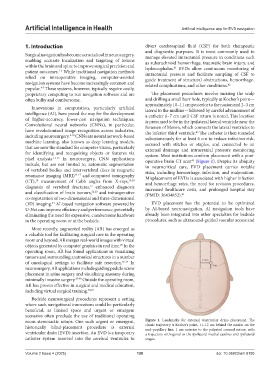
            pixel analysis. 11-13  In neurosurgery, CNN applications   operative brain CT scan  (Figure 1). Despite its ubiquity
                                                                                  43
            include, but are not limited to, automatic segmentation   in neurocritical care, EVD  placement  carries  notable
            of  vertebral  bodies  and  intervertebral  discs  in  magnetic   risks, including hemorrhage, infection, and malposition.
            resonance imaging (MRI) 14-17  and computed tomography   Misplacement of EVDs is associated with higher infection
            (CT),   measurement  of  Cobb angles  from  X-rays, 19,20    and hemorrhage rates, the need for revision procedures,
                18
            diagnosis  of  vertebral fractures,   enhanced  diagnosis   increased healthcare costs, and prolonged hospital stay
                                       21
            and classification of brain tumors, 22,23  and intraoperative   (PMID: 36434852). 41
            co-registration of two-dimensional and three-dimensional
                       24
            (3D) imaging.  AI-based navigation software powered by   EVD  placement  has  the  potential  to  be  optimized
            U-Net can improve efficiency and performance, potentially   by AI-based neuronavigation. AI navigation tools have
            eliminating the need for expensive, cumbersome hardware   already been integrated into other specialties for bedside
            in the operating room or at the bedside.           procedures, such as ultrasound-guided vascular access and
              More recently, augmented reality (AR) has emerged as
            a valuable tool for facilitating surgical care in the operating
            room and beyond. AR merges real-world images with virtual
                                                    25
            objects generated by computer graphics in real time.  In the
            operating room, AR has found applications in visualizing
            tumors and surrounding anatomical structures in a number
            of oncological settings to facilitate safe resection. 26-34  In
            neurosurgery, AR applications include guiding pedicle screw
            placement in spine surgery and visualizing anatomy during
            minimally invasive surgery. 35-38  Outside the operating room,
            AR has proven effective in surgical and medical education,
            including virtual surgical training. 39,40

              Bedside neurosurgical procedures represent a setting
            where such navigational innovations could be particularly
            beneficial, as limited space and urgent or emergent
            scenarios often preclude the use of traditional operating
            room stereotactic setups. One such urgent or emergent,   Figure  1.  Landmarks for external ventricular drain placement. The
            historically blind-placement procedure is external   classic trajectory is Kocher’s point, 11–12 cm behind the nasion on the
                                                               mid-pupillary line, 1  cm anterior to the palpated coronal suture, with
            ventricular drain (EVD) insertion. An EVD is a temporary   a trajectory orthogonal to the ipsilateral medial canthus and ipsilateral
            catheter system inserted into the cerebral ventricles to   tragus.


            Volume 2 Issue 4 (2025)                        130                               doi: 10.36922/aih.8195

