


Page 66 - AIH-2-4
P. 66
Artificial Intelligence in Health                                   Synthetic data for obesity level prediction


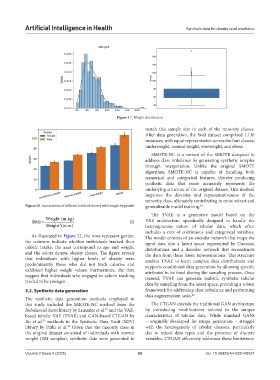
                                                   Figure 17. Weight distribution


                                                               match this sample size in each of the minority classes.
                                                               After data generation, the final dataset comprised 1,136
                                                               instances, with equal representation across the four classes:
                                                               underweight, normal weight, overweight, and obese.
                                                                 SMOTE-NC is a variant of the SMOTE designed to
                                                               address  class imbalance  by generating  synthetic  samples
                                                               through interpolation. Unlike the original SMOTE
                                                               algorithm, SMOTE-NC is capable of handling both
                                                               numerical and categorical features, thereby producing
                                                               synthetic data that more accurately represents the
                                                               underlying structure of the original dataset. This method
                                                               improves  the  diversity  and representativeness  of  the
                                                               minority class, ultimately contributing to more robust and
            Figure 18. Associations of different levels of obesity with weight by gender  generalizable model training. 39
                                                                 The TVAE is a generative model based on the
                    Weight (in kg)
               BMI =                                    (I)    VAE architecture, specifically designed to handle the
                          2
                     Height (in m)                             heterogeneous nature of tabular data, which often
                                                               includes a mix of continuous and categorical variables.
              As illustrated in Figure 22, the rows represent gender,   The model consists of an encoder network that maps the
            the columns indicate whether individuals tracked their   input data into a latent space represented by Gaussian
            caloric intake, the axes correspond to age and weight,   distributions and a decoder network that reconstructs
            and the colors denote obesity classes. The  figure reveals   the data from these latent representations. This structure
            that individuals with higher levels of obesity were   enables TVAE to learn complex data distributions and
            predominantly those who did not track calories and   supports conditional data generation by allowing specific
            exhibited higher weight values. Furthermore, the data   attributes to be fixed during the sampling process. Once
            suggest that individuals who engaged in calorie tracking   trained, TVAE can generate realistic synthetic tabular
            tended to be younger.
                                                               data by sampling from the latent space, providing a robust
            3.2. Synthetic data generation                     framework for addressing class imbalance and performing
                                                               data augmentation tasks. 40
            The synthetic data generation methods employed in
            this study included the SMOTE-NC method from the     The CTGAN extends the traditional GAN architecture
            Imbalanced-learn library by Lemaître et al.  and the VAE-  by introducing  modifications tailored to  the  unique
                                              36
            based tabular VAE (TVAE) and GAN-based CTGAN by    characteristics  of tabular data.  While  standard GANs
            Xu  et al.  methods in the Synthetic Data Vault (SDV)   – originally developed for image generation – struggle
                   37
            library by Patki  et al.  Given that the majority class in   with the heterogeneity of tabular datasets, particularly
                              38
            the original dataset consisted of individuals with normal   due to mixed data types and the presence of discrete
            weight (284  samples), synthetic data were generated to   variables, CTGAN effectively addresses these limitations.

            Volume 2 Issue 4 (2025)                         60                          doi: 10.36922/AIH025140027

