


Page 67 - AIH-2-4
P. 67
Artificial Intelligence in Health                                   Synthetic data for obesity level prediction


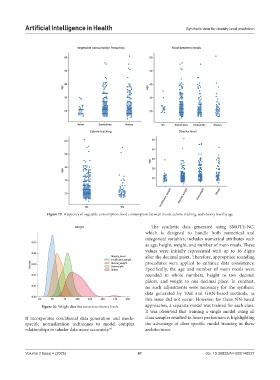
                     Figure 19. Frequency of vegetable consumption, food consumption between meals, calorie tracking, and obesity level by age

                                                                 The  synthetic  data  generated  using  SMOTE-NC,
                                                               which is designed to handle both numerical and
                                                               categorical variables, includes numerical attributes such
                                                               as age, height, weight, and number of main meals. These
                                                               values were initially represented with up to 16 digits
                                                               after the decimal point. Therefore, appropriate rounding
                                                               procedures were applied to enhance data consistency.
                                                               Specifically, the age and number of main meals were
                                                               rounded to whole numbers, height to two decimal
                                                               places, and weight to one decimal place. In contrast,
                                                               no such adjustments were necessary for the synthetic
                                                               data generated by VAE and GAN-based methods, as
                                                               this issue did not occur. However, for these NN-based
                   Figure 20. Weight distribution across obesity levels  approaches, a separate model was trained for each class.
                                                               It was observed that training a single model using all
            It incorporates conditional data generation and mode-  class samples resulted in lower performance, highlighting
            specific  normalization  techniques  to  model  complex   the advantage of class-specific model training in these
            relationships in tabular data more accurately. 41  architectures.


            Volume 2 Issue 4 (2025)                         61                          doi: 10.36922/AIH025140027

