


Page 70 - AIH-2-4
P. 70
Artificial Intelligence in Health                                   Synthetic data for obesity level prediction


            coefficient of 0.85, was identified between obesity level and   In addition to encoding, the dataset was standardized
            weight, indicating a strong positive relationship.  using the StandardScaler function from the Scikit-learn
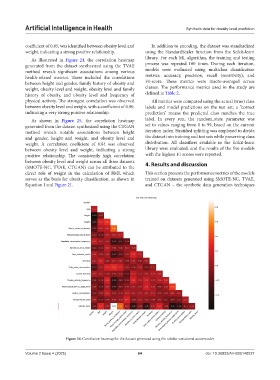
              As illustrated in  Figure  24, the correlation heatmap   library. For each ML algorithm, the training and testing
            generated from the dataset synthesized using the TVAE   process was repeated 100  times. During each iteration,
            method  reveals  significant  associations  among  various   models were evaluated using multiclass classification
            health-related metrics. These included the correlations   metrics: accuracy, precision, recall (sensitivity), and
            between height and gender, family history of obesity and   F1-score.  These  metrics  were  macro-averaged  across
            weight, obesity level and weight, obesity level and family   classes.  The  performance  metrics  used in  the  study are
            history of obesity, and obesity level and frequency of   defined in Table 2.
            physical activity. The strongest correlation was observed   All metrics were computed using the actual (true) class
            between obesity level and weight, with a coefficient of 0.90,   labels and model predictions on the test set; a “correct
            indicating a very strong positive relationship.    prediction” means the predicted class matches the true
              As  shown  in  Figure  25,  the  correlation  heatmap   label. In every run, the random_state parameter was
            generated from the dataset synthesized using the CTGAN   set to values ranging from 0 to 99, based on the current
            method reveals notable associations between height   iteration index. Stratified splitting was employed to divide
            and  gender,  height  and weight,  and obesity  level  and   the dataset into training and test sets while preserving class
            weight. A  correlation coefficient of 0.84 was observed   distribution. All classifiers available in the Scikit-learn
            between obesity level and weight, indicating a strong   library were evaluated, and the results of the five models
            positive relationship. The consistently high correlation   with the highest F1 scores were reported.
            between obesity level and weight across all three datasets
            (SMOTE-NC, TVAE, CTGAN) can be attributed to the   4. Results and discussion
            direct role of weight in the calculation of BMI, which   This section presents the performance metrics of the models
            serves as the basis for obesity classification, as shown in   trained on datasets generated using SMOTE-NC, TVAE,
            Equation I and Figure 21.                          and CTGAN – the synthetic data generation techniques


                             Figure 24. Correlation heatmap for the dataset generated using the tabular variational autoencoder


            Volume 2 Issue 4 (2025)                         64                          doi: 10.36922/AIH025140027

