


Page 73 - AIH-2-4
P. 73
Artificial Intelligence in Health                                   Synthetic data for obesity level prediction


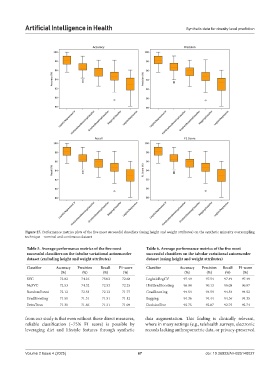
            Figure 27. Performance metrics plots of the five most successful classifiers (using height and weight attributes) on the synthetic minority oversampling
            technique—nominal and continuous dataset

            Table 5. Average performance metrics of the five most   Table 6. Average performance metrics of the five most
            successful classifiers on the tabular variational autoencoder   successful classifiers on the tabular variational autoencoder
            dataset (excluding height and weight attributes)   dataset (using height and weight attributes)
            Classifier   Accuracy   Precision   Recall   F1‑score   Classifier  Accuracy   Precision   Recall   F1‑score
                           (%)      (%)      (%)     (%)                       (%)       (%)     (%)    (%)
            SVC           73.02     74.16   73.02    72.68     LogisticRegCV   97.49     97.54  97.49   97.49
            NuSVC         72.53     74.32   72.53    72.25     HistGradBoosting  96.08   96.13  96.08   96.07
            RandomForest  72.12     72.53   72.12    71.77     GradBoosting    94.54     94.59  94.54   94.52
            GradBoosting  71.51     71.31   71.51    71.12     Bagging         94.36     94.44  94.36   94.35
            ExtraTrees    71.31     71.66   71.31    71.09     DecisionTree    92.75     92.87  92.75   92.74


            from our study is that even without those direct measures,   data augmentation. This finding is clinically relevant,
            reliable  classification (~75%  F1 score) is possible  by   where in many settings (e.g., telehealth surveys, electronic
            leveraging diet and lifestyle features through synthetic   records lacking anthropometric data, or privacy-preserved


            Volume 2 Issue 4 (2025)                         67                          doi: 10.36922/AIH025140027

