


Page 71 - AIH-2-4
P. 71
Artificial Intelligence in Health                                   Synthetic data for obesity level prediction


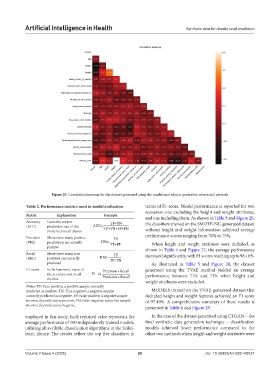
                       Figure 25. Correlation heatmap for the dataset generated using the conditional tabular generative adversarial network

            Table 2. Performance metrics used in model evaluation  terms of F1-score. Model performance is reported for two
                                                               scenarios: one excluding the height and weight attributes,
            Metric       Explanation         Formula
                                                               and one including them. As shown in Table 3 and Figure 26,
            Accuracy   Gives the correct        TP+TN          the classifiers trained on the SMOTE-NC-generated dataset
            (ACC)    prediction rate of the   ACC=  TP+TN+FP+FN
                     model across all classes                  without height and weight information achieved average
            Precision   Shows how many positive   TP           performance scores ranging from 70% to 75%.
            (PRE)    predictions are actually   PRE=  TP+FP      When height and weight attributes were included, as
                     positive                                  shown in Table 4 and Figure 27, the average performance
            Recall   Shows how many true         TP            increased significantly, with F1 scores reaching up to 98.16%.
            (REC)    positives are correctly   REC= TP+FN
                     predicted                                   As illustrated in  Table 5 and  Figure  28, the dataset
            F1-score  Is the harmonic mean of   Precisionx Recall  generated using the TVAE method yielded an average
                     the accuracy and recall   F1=2x           performance between 71% and 73% when height and
                     metrics                 Precision +Recall
                                                               weight attributes were excluded.
            Notes: TP: True positive; a positive sample correctly
            predicted as positive. TN: True negative; a negative sample   MODELS trained on the TVAE-generated dataset that
            correctly predicted as negative. FP: False positive; a negative sample   included height and weight features achieved an F1 score
            incorrectly predicted as positive. FN: False negative; a positive sample   of 97.49%. A comprehensive summary of these results is
            incorrectly predicted as negative.
                                                               presented in Table 6 and Figure 29.
            employed in this study. Each reported value represents the   In the case of the dataset generated using CTGAN – the
            average performance of 100 independently trained models,   final synthetic data generation technique – classification
            utilizing all available classification algorithms in the Scikit-  models achieved lower performance compared to the
            learn library. The results reflect the top five classifiers in   other two methods when height and weight attributes were


            Volume 2 Issue 4 (2025)                         65                          doi: 10.36922/AIH025140027

