


Page 69 - AIH-2-4
P. 69
Artificial Intelligence in Health                                   Synthetic data for obesity level prediction


            and calorie tracking, “no” responses were encoded as 0   transportation” was assigned the base value 0, whereas in
            and “yes” responses as 1.                          the other version, “walking” was assigned 0. The results of
              Label encoding was applied to attributes that exhibit an   ML models showed no significant difference between these
            ordinal relationship among their values. These attributes   two approaches. As a result, the final version of the dataset
            include frequency of vegetable consumption, food   adopted the encoding that prioritized “walking,” with
            consumption between meals, daily water consumption,   values ranging from 0 to 4. The obesity level, designated as
            frequency of physical activity, duration of technological   the class label, was encoded from 0 to 3, where 0 represents
            device  use,  alcohol  consumption,  transportation  the lowest level (underweight), and 3 represents the highest
            preference, and obesity level (class label).       level (obese).
              For frequency of vegetable consumption, the categories   Following the encoding process, correlation heatmaps
            “never,” “sometimes,” and “always” were encoded as 0, 1, and   were  generated  for  each  of the datasets  created  using
            2, respectively. The responses “no,” “sometimes,” “often,” and   SMOTE-NC,  TVAE,  and  CTGAN.  These  heatmaps
            “always” for food consumption between meals were encoded   were used to visualize the relationships between the
            as 0, 1, 2, and 3. Daily water consumption categories – “less   attributes, where values close to 1 indicate strong positive
            than 1 liter,” “between 1 and 2 liters,” and “more than 2 liters”   correlations and values close to − 1 indicate strong
            – were encoded as 1, 2, and 3. For frequency of physical   negative correlations.
            activity, the categories “no activity,” “1–2 days,” “2–4 days,”   The correlation heatmap generated from the dataset
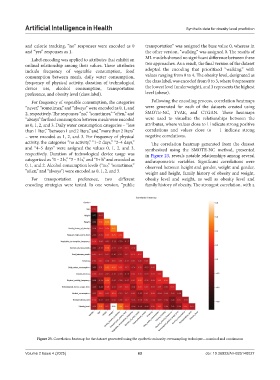
            and “4–5  days” were assigned the values 0, 1, 2, and 3,   synthesized using the SMOTE-NC method, presented
            respectively. Duration of technological device usage was   in Figure 23, reveals notable relationships among several
            categorized as “0 – 2 h,” “3 – 5 h,” and “5+ h” and encoded as   anthropometric variables. Significant correlations were
            0, 1, and 2. Alcohol consumption levels (“no,” “sometimes,”   observed between height and gender, weight and gender,
            “often,” and “always”) were encoded as 0, 1, 2, and 3.  weight and height, family history of obesity and weight,
              For   transportation  preference,  two  different  obesity level and weight, as well as obesity level and
            encoding  strategies  were  tested.  In  one  version,  “public   family history of obesity. The strongest correlation, with a


                 Figure 23. Correlation heatmap for the dataset generated using the synthetic minority oversampling technique—nominal and continuous


            Volume 2 Issue 4 (2025)                         63                          doi: 10.36922/AIH025140027

