


Page 72 - AIH-2-4
P. 72
Artificial Intelligence in Health                                   Synthetic data for obesity level prediction


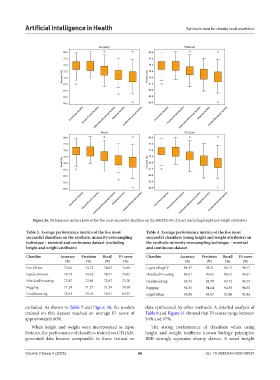
               Figure 26. Performance metrics plots of the five most successful classifiers on the SMOTE-NC dataset (excluding height and weight attributes)

            Table 3. Average performance metrics of the five most   Table 4. Average performance metrics of the five most
            successful classifiers on the synthetic minority oversampling   successful classifiers (using height and weight attributes) on
            technique – nominal and continuous dataset (excluding   the synthetic minority oversampling technique – nominal
            height and weight attributes)                      and continuous dataset
            Classifier     Accuracy   Precision   Recall   F1‑score   Classifier  Accuracy   Precision   Recall   F1‑score
                             (%)      (%)     (%)    (%)                        (%)      (%)     (%)    (%)
            ExtraTrees      74.62    74.72   74.62   74.48     LogisticRegCV   98.17     98.21  98.17   98.17
            RandomForest    74.71    74.62   74.71   74.45     HistGradBoosting  96.61   96.65  96.61   96.61
            HistGradBoosting  72.87  72.89   72.87   72.70     GradBoosting    95.73     95.79  95.73   95.73
            Bagging         71.24    71.27   71.24   70.98     Bagging         94.55     94.64  94.55   94.55
            GradBoosting    70.31    70.19   70.31   69.91     LogisticReg     92.86     93.03  92.86   92.86


            excluded. As shown in Table 7 and Figure 30, the models   data synthesized by other methods. A detailed analysis of
            trained on this dataset reached an average F1 score of   Table 8 and Figure 31 showed that F1 scores range between
            approximately 60%.                                 94% and 97%.
              When height and weight were incorporated as input   The strong performance of classifiers when using
            features, the performance of classifiers trained on CTGAN-  height and weight reaffirms known biology principles:
            generated data became comparable to those trained on   BMI strongly separates obesity classes. A  novel insight


            Volume 2 Issue 4 (2025)                         66                          doi: 10.36922/AIH025140027

