


Page 77 - AIH-2-4
P. 77
Artificial Intelligence in Health                                   Synthetic data for obesity level prediction


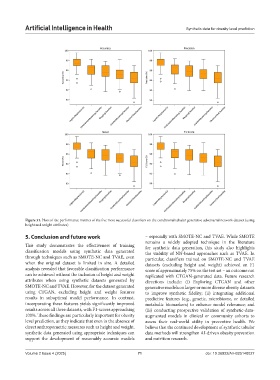
            Figure 31. Plots of the performance metrics of the five most successful classifiers on the conditional tabular generative adversarial network dataset (using
            height and weight attributes)

            5. Conclusion and future work                      – especially with SMOTE-NC and TVAE. While SMOTE
                                                               remains a widely adopted technique in the literature
            This study demonstrates the effectiveness of training   for synthetic data generation, this study also highlights
            classification models using synthetic data generated   the viability of NN-based approaches such as TVAE. In
            through techniques such as SMOTE-NC and TVAE, even   particular, classifiers trained on SMOTE-NC and TVAE
            when the original dataset is limited in size. A  detailed   datasets (excluding height and weight) achieved an F1
            analysis revealed that favorable classification performance   score of approximately 75% on the test set – an outcome not
            can be achieved without the inclusion of height and weight   replicated with CTGAN-generated data. Future research
            attributes when using synthetic datasets generated by   directions include: (i) Exploring CTGAN and other
            SMOTE-NC and TVAE. However, for the dataset generated   generative models on larger or more diverse obesity datasets
            using CTGAN, excluding height and weight features   to improve synthetic fidelity; (ii) integrating additional
            results in suboptimal model performance. In contrast,   predictive features (e.g., genetic, microbiome, or detailed
            incorporating these features yields significantly improved   metabolic  biomarkers) to  enhance model  relevance; and
            results across all three datasets, with F1-scores approaching   (iii) conducting prospective validation of synthetic-data-
            100%. These findings are particularly important for obesity   augmented models in clinical or community cohorts to
            level prediction, as they indicate that even in the absence of   assess their real-world utility in preventive health. We
            direct anthropometric measures such as height and weight,   believe that the continued development of synthetic tabular
            synthetic data generated using appropriate techniques can   data methods will strengthen AI-driven obesity prevention
            support the development of reasonably accurate models   and nutrition research.


            Volume 2 Issue 4 (2025)                         71                          doi: 10.36922/AIH025140027

