


Page 84 - AIH-2-4
P. 84
Artificial Intelligence in Health                            Federated learning health stack against pandemics


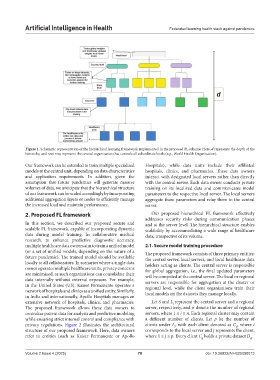
            Figure 1. Schematic representation of the hierarchical learning framework implemented in the proposed FL scheme. Here, d represents the depth of the
            hierarchy, and root may represent the central organization that controls all subordinate levels (e.g., World Health Organization).

            Our framework can be extended to train multiple specialized   Hospitals), while data units include their affiliated
            models at the central unit, depending on data characteristics   hospitals, clinics, and pharmacies. These data owners
            and application requirements. In addition, given the   interact with designated local servers rather than directly
            assumption that future pandemics will generate massive   with the central server. Each data owner conducts private
            volumes of data, we anticipate that the hierarchical structure   training on its localized data and communicates  model
            of our framework can be scaled accordingly by incorporating   parameters to the respective local server. The local servers
            additional aggregation layers or nodes to efficiently manage   aggregate these parameters and relay them to the central
            the increased load and maintain performance.       server.
            2. Proposed FL framework                             Our proposed hierarchical FL framework effectively
                                                               addresses security risks during communication phases
            In  this section,  we described  our  proposed  secure  and   and at the server level. The hierarchical structure enables
            scalable FL framework, capable of incorporating dynamic   scalability by accommodating a wide range of healthcare
            data during model training. In collaborative medical   data, irrespective of its volume.
            research, to enhance predictive diagnostic accuracy,
            multiple healthcare data owners aim to train a unified model   2.1. Secure model training procedure
            (or a set of unified models, depending on the nature of a   The proposed framework consists of three primary entities:
            future pandemic). The trained model should be available   the central server, local servers, and local healthcare data
            locally to all collaborators. In scenarios where a single data   holders acting as clients. The central server is responsible
            owner operates multiple healthcare units, privacy concerns   for global aggregation, i.e., the final updated parameters
            are minimized, as such organizations can consolidate their   will be computed at the central server. The local or regional
            data internally without external exposure. For example,   servers are responsible for aggregation at the cluster or
            in the United States (US), Kaiser Permanente operates a   regional level, while the client organizations train their
            network of hospitals and clinics as a unified entity. Similarly,   local models on the datasets they manage locally.
            in India and internationally, Apollo Hospitals manages an
            extensive network of hospitals, clinics, and pharmacies.   Let S and L represent the central server and a regional
                                                                           i
            The proposed framework allows these data owners to   server, respectively, and n denote the number of regional
            centralize patient data for analysis and predictive modeling   servers, where 1 ≤ i ≤ n. Each regional cluster may contain
            while ensuring strict internal control and compliance with   a different number of clients. Let  p be the number of
            privacy regulations.  Figure  2 illustrates the architectural   clients under L, with each client denoted as C , where i
                                                                           i
                                                                                                     ij
            structure of our proposed framework. Here, data owners   corresponds to the local server and j represents the client,
            refer to entities (such as Kaiser Permanente or Apollo   where 1 ≤ j ≤ p. Every client C  holds a private dataset D .
                                                                                       ij                  ij
            Volume 2 Issue 4 (2025)                         78                          doi: 10.36922/AIH025080013

