


Page 86 - AIH-2-4
P. 86
Artificial Intelligence in Health                            Federated learning health stack against pandemics


            updated model parameters  G , generating new model   poisoned updates, such as label-flipping or trimmed mean
                                     r
            parameters for round r + 1, represented as:        methods, to induce global model divergence. Experiments
                                                               have shown that only 10% of such malicious clients may
            G r1   train Gb(  r ,  r1 )             (VI)    reduce model accuracy by up to 33.1%,  which highlights
              ij
                           ij
                                                                                              24
              The hierarchical communication process is repeated   the need for robustness against such attacks.
            using HE for  each subsequent round. This process    Another urgent concern is privacy leakage. Even if raw
            continues until either the final round  R is reached or   data  is  retained  locally,  leakage  of  gradient  distributions
            the model converges. The workflow of our  proposed   might compromise sensitive information. Attacks on
            framework is  diagrammatically represented in  Figure  3,   medical imaging data, for example, have resulted in up to
            and the algorithm is as follows:
                                                               74.24% reconstruction success rates for all data samples
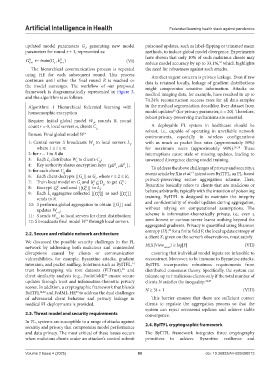
             Algorithm: 1 Hierarchical federated learning with   in the medical segmentation decathlon liver dataset from
                                                                           25
             homomorphic encryption                            model updates  (for privacy parameter, ε = 20). Therefore,
                                                               robust privacy-preserving mechanisms are essential.
             Require: Initial global model  W , rounds  R, round
                                         0
             count r = 0, local servers n, clients C ij          A  deployable  FL  system  in  healthcare  should  be
             Ensure: Final global model W*                     robust, i.e., capable of operating in unreliable network
                                                               environments, especially in wireless configurations
             1: Central server  S  broadcasts  W  to local servers  L,   with as much as packet loss rates (approximately 10%)
                                         0
                                                        i
                 where 1 ≤ i ≤ n;                              for maximum users (approximately 90%). 26,14  These
             2: for r = 1 to R do                              interruptions cause stale or missing updates, leading to
             3:  Each L distributes W  to clients C ;          unwanted divergence during model training.
                      i
                                 o
                                           ij
             4:  Key authority shares encryption keys  (pk ij r ,sk ij r ) ;  To address the above challenges of privacy and security, a
             5: for each client C  do                          recent article by Xia et al.  introduces ByITFL, an FL-based
                            ij
                                                                                  14
             6:  Each client decrypts [[G ]] as G , where r ≤ 2 ≤ R;  privacy-preserving  secure aggregation scheme. Here,
                                    r
                                          r
                                                     ij
             7:  Train local model on G  and  b ij r    D⊆  ij   to get  G ;
                                   r
                                                     r
                         ij
             8:  Encrypt  G  and send [[G r ij ]]  to L; i     Byzantine basically refers to clients that are malicious or
                         r
             9:  Each L aggregates collected  [[G r ij ]]  as and  [[ ]]G i r     behave arbitrarily, typically with the intention of poisoning
                      i
                 sends to S;                                   training. ByITFL is designed to maintain the integrity
             10:  S performs global aggregation to obtain [[G ]] and   and confidentiality of model updates during aggregation,
                                                    r
                 updates W ;                                   without relying on computational assumptions. The
                         r+1
             11:  S sends W  to local servers for client distribution;  scheme is information-theoretically private, i.e., even a
                         r+1
             12: S broadcasts final model W* through local servers.  semi-honest or curious server learns nothing beyond the
                                                               aggregated gradients. Privacy is quantified using Shannon
                                                               entropy (H):  for a finite field F, the local update entropy of
                                                                         22
            2.2. Secure and reliable network architecture
                                                               a client X, given on the server’s observations, must satisfy
            We discussed the possible security challenges in the FL
            network by addressing both malicious and unintended   H(X|View server ) ≥ log|F|             (VII)
            disruptions caused by clients or communication       ensuring that individual model inputs are infeasible to
            vulnerabilities, for example, Byzantine attacks, gradient   reconstruct. Moreover, to be immune to Byzantine attacks,
            inversion, and packet sniffing. Solutions such as ByITFL,    ByITFL incorporates robustness requirements from
                                                         14
            trust bootstrapping via root datasets (FLTrust),  and   distributed consensus theory. Specifically, the system can
                                                     20
            client similarity analysis (e.g., FoolsGold)  ensure secure   tolerate up to t malicious clients only if the total number of
                                             21
            updates through trust and information-theoretic privacy   clients N satisfies the inequality: 14,27
            scores. In addition, a cryptographic framework that blends   N ≥ 3t + 1                     (VIII)
                                 23
            ByITFL 14,22  and FedML-HE  to address the dual challenges
            of  adversarial  client  behavior  and  privacy  leakage  in   This barrier ensures that there are sufficient correct
            medical FL deployments is provided.                clients  to  regulate  the  aggregation process so  that  the
                                                               system can reject erroneous updates and achieve stable
            2.3. Threat model and security requirements        convergence.
            In FL, systems are susceptible to a range of attacks against   2.4. ByITFL cryptographic framework
            security and privacy that compromise model performance
            and data privacy. The most critical of these issues occurs   The ByITFL framework integrates three cryptography
            when malicious clients under an attacker’s control submit   primitives  to  achieve  Byzantine  resilience  and
            Volume 2 Issue 4 (2025)                         80                          doi: 10.36922/AIH025080013

