


Page 90 - AIH-2-4
P. 90
Artificial Intelligence in Health                            Federated learning health stack against pandemics


            90.0% in classifying smart contract vulnerabilities. The   real-world medical datasets and can therefore be used as
            model’s performance was evaluated using various metrics,   a reliable data proxy. MNIST consists of 70,000 grayscale
            including precision, recall, F1 score, confusion matrix, and   images, with 60,000 images used for training and 10,000
            receiver operating characteristic curves, demonstrating   for testing. Each image is 28 × 28 pixels and encoded with
            its effectiveness in detecting vulnerabilities compared to   intensity values ranging from 0 to 255.
            random guessing.                                     For model training, a CNN architecture was designed
            3. Results                                         with an input layer, two hidden layers activated by ReLU
                                                               functions, and an output layer generating a probability
            In this section, the cost-effectiveness and performance of   distribution over 10 classes using a softmax function. The
            the proposed hierarchical FL framework were theoretically   model was trained for 30 communication rounds. In the
            and experimentally analyzed. The analyses considered   baseline FedAvg setup, the simulation involved 12 and
            both communication costs and computation costs for all   21 clients and a single central server. For the hierarchical
            entities involved in the training process: Clients, local   FL implementation, two configurations were tested:
            servers, and the central server. To demonstrate the utility   first, with four local servers, each connected to three
            of the proposed framework, the observed accuracy was   client nodes (totaling 12 nodes, matching the first non-
            compared with the benchmark FL algorithm, FedAvg,    hierarchical case), and one central server coordinating the
                                                         53
            with fine-tuning.                                  aggregation; second, with three local servers and seven
                                                               clients per server (totaling 21 nodes, corresponding to the
            3.1. Experimental evaluation
                                                               second non-hierarchical case), and a central server. The
            The experiments were conducted using the structure   learning rate was set to 0.01, and each client performed
            of Flower Framework,  extended to support both a   three  local  training  epochs  per  round.  Throughout  the
                               54
            standard FedAvg setup and the proposed hierarchical FL   training process, both training time and accuracy at each
            framework. Python 3.10.12 (Phyton software foundation,   round were monitored to compare model performance.
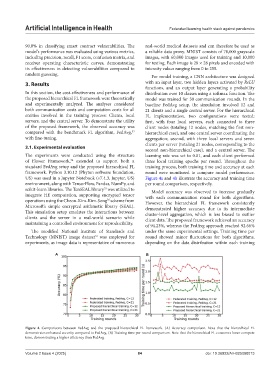
            US) was used in a Jupyter Notebook (v7.4.3, Jupyter, US)   Figure 4a and 4b illustrate the accuracy and training time
            environment, along with TensorFlow, Pandas, NumPy, and   per round comparison, respectively.
            scikit-learn libraries. The TenSEAL library  was utilized to   Model accuracy was observed to increase gradually
                                             55
            integrate HE computation, supporting encrypted tensor   with each communication round for both algorithms.
            operations using the Cheon-Kim-Kim-Song  scheme from   However, the hierarchical FL framework consistently
                                               56
            Microsoft’s simple encrypted arithmetic library (SEAL).   demonstrated higher accuracy due  to its  intermediate
            This simulation setup emulates the interactions between   cluster-level aggregation, which is less biased to outlier
            clients and the server in a real-world scenario while   client data. The proposed framework achieved an accuracy
            maintaining a controlled environment for reproducibility.  of 94.23%, whereas the FedAvg approach reached 92.66%

              The  modified  National Institute of  Standards  and   under the same experimental settings. Training time per
            Technology (MNIST) image dataset  was employed for   round showed minor fluctuations for both algorithms,
                                          57
            experiments, as image data is representative of numerous   depending on the data distribution within each training

                         A                                     B


            Figure  4.  Comparisons between FedAvg and the proposed hierarchical FL framework. (A) Accuracy comparison. Note that the hierarchical FL
            demonstrates enhanced security compared to FedAvg. (B) Training time per round comparison. Note that the hierarchical FL consumes lesser compute
            time, demonstrating a higher efficiency than FedAvg.


            Volume 2 Issue 4 (2025)                         84                          doi: 10.36922/AIH025080013

