


Page 151 - AJWEP-22-4
P. 151
HR and logistics in flood response

                and professionals at 3.9%. Respondents possessed    independence. Ensuring low multicollinearity is crucial
                an average of 15 years of experience in humanitarian   for  interpreting  the  path  coefficients  (β) reliably, as
                missions,  reflecting  substantial  field  expertise  that   high  multicollinearity  can  inflate  standard  errors  and
                enhances the validity and depth of the collected data. 19  distort the significance of estimated effects. Therefore,
                                                                    the low VIF values support the validity of the model’s
                2.3. Data analysis                                  structure and the integrity of its conclusions regarding
                The  analysis  of quantitative  data  was conducted   the  influence  of  HRM  and  logistics  coordination  on
                utilizing SmartPLS version 3.2.8, which is recognized   humanitarian performance.
                as a premier software for PLS-SEM.  PLS-SEM was
                                                 21
                chosen for its capability  to estimate  intricate  models   3. Results
                involving  latent constructs and its appropriateness for
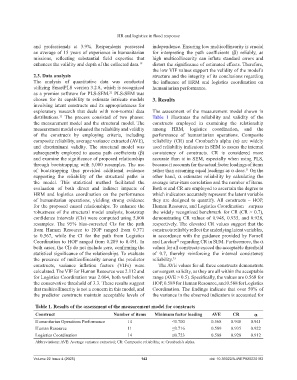
                exploratory  research  that  deals  with  non-normal  data   The assessment of the measurement  model  shown in
                distributions.   The process consisted of two phases:   Table  1 illustrates  the reliability  and validity  of the
                           11
                the measurement model and the structural model. The   constructs employed in examining  the relationship
                measurement model evaluated the reliability and validity   among  HRM, logistics  coordination,  and  the
                of the constructs by employing criteria, including   performance  of humanitarian  operations. Composite
                composite reliability, average variance extracted (AVE),   reliability  (CR) and Cronbach’s  alpha (α) are widely
                and discriminant validity.  The structural model was   used reliability indicators in SEM to assess the internal
                subsequently  employed  to  assess  path  coefficients  (β)   consistency of constructs. CR is considered more
                and examine the significance of proposed relationships   accurate than α in SEM, especially when using PLS,
                through bootstrapping with 5,000 resamples. The use   because it accounts for the actual factor loadings of items
                of bootstrapping  thus provided  additional  evidence   rather than assuming equal loadings as α does.  On the
                                                                                                             11
                supporting  the  reliability  of the  structural  paths  in   other hand,  α estimates  reliability  by calculating  the
                the  model.  This  statistical  method  facilitated  the   average inter-item correlation and the number of items.
                evaluation  of both direct and indirect  impacts  of   Both α and CR are employed to ascertain the degree to
                HRM and  logistics  coordination  on  the  performance   which indicators accurately represent the latent variable
                of humanitarian operations, yielding  strong evidence   they  are  designed  to  quantify. All  constructs  – HOP,
                for the proposed causal relationships. To enhance the   Human Resource, and Logistics Coordination – surpass
                robustness of the structural  model analysis, bootstrap   the widely recognized benchmark for CR (CR > 0.7),
                confidence intervals (CIs) were computed using 5,000   demonstrating CR values of 0.948, 0.935, and 0.928,
                resamples.  The  95%  bias-corrected  CIs for  the  path   respectively. The elevated CR values suggest that the
                from Human Resource to HOP ranged from 0.371        constructs reliably reflect the underlying latent variables,
                to  0.567,  while  the  CI for  the  path  from  Logistics   in accordance with the guidance provided by Fornell
                Coordination to HOP ranged from 0.289 to 0.491. In   and Larcker  regarding CR in SEM. Furthermore, the α
                                                                               22
                both cases, the CIs do not include zero, confirming the   values for all constructs exceed the acceptable threshold
                statistical significance of the relationships. To evaluate   of 0.7, thereby  reinforcing  the internal  consistency
                the presence of multicollinearity among the predictor   reliability. 23
                constructs,  variance  inflation  factors  (VIFs)  were   The AVE values for all three constructs demonstrate
                calculated. The VIF for Human Resource was 2.112 and   convergent validity, as they are all within the acceptable
                for Logistics Coordination was 2.004, both well below   range (AVE > 0.5). Specifically, the values are 0.568 for
                the conservative threshold of 3.3. These results suggest   HOP, 0.589 for Human Resource, and 0.588 for Logistics
                that multicollinearity is not a concern in this model, and   Coordination. The findings indicate that over 50% of
                the predictor constructs maintain acceptable levels of   the variance in the observed indicators is accounted for

                 Table 1. Results of the assessment of the measurement model for constructs
                 Construct                         Number of items   Minimum factor loading   AVE       CR       α
                 Humanitarian Operations Performance     14                  ≤0.700           0.568    0.948   0.941
                 Human Resource                          11                  ≤0.716           0.589    0.935   0.922
                 Logistics Coordination                  14                  ≤0.723           0.588    0.928   0.912
                 Abbreviations: AVE: Average variance extracted; CR: Composite reliability; α: Cronbach’s alpha.


                Volume 22 Issue 4 (2025)                       143                           doi: 10.36922/AJWEP025220182

