


Page 152 - AJWEP-22-4
P. 152
Jusoh and Alwi

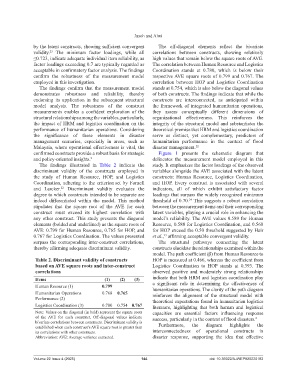
                by the latent constructs, showing sufficient convergent   The  off-diagonal  elements  reflect  the  bivariate
                validity.   The  minimum  factor  loadings,  while  all   correlations between constructs, showing relatively
                       23
                ≤0.723, indicate adequate individual item reliability, as   high values that remain below the square roots of AVE.
                factor loadings exceeding 0.7 are typically regarded as   The correlation between Human Resource and Logistics
                acceptable in confirmatory factor analysis. The findings   Coordination  stands  at  0.780, which  is below  their
                confirm  the  robustness  of  the  measurement  model   respective AVE square roots of 0.799 and 0.767. The
                employed in this investigation.                     correlation  between  HOP  and  Logistics  Coordination
                  The  findings  confirm  that  the  measurement  model   stands at 0.754, which is also below the diagonal values
                demonstrates robustness and reliability, thereby    of both constructs. The findings indicate that while the
                endorsing  its  application  in  the  subsequent  structural   constructs are interconnected, as anticipated  within
                model  analysis.  The  robustness of the  construct   the framework of integrated  humanitarian  operations,
                measurements  enables  a  confident  exploration  of  the   they  assess  conceptually  different  dimensions  of
                structural relationships among the variables, particularly,   organizational  effectiveness.  This  reinforces  the
                the impact of HRM and logistics coordination on the   integrity of the structural model and substantiates the
                performance of humanitarian  operations. Considering   theoretical premise that HRM and logistics coordination
                the  significance  of  these  elements  in  disaster   serve as distinct,  yet complementary, predictors  of
                management  scenarios,  especially  in  areas,  such as   humanitarian  performance  in  the  context  of  flood
                Malaysia, where operational effectiveness is vital, the   disaster management. 22
                confirmed constructs provide a robust basis for strategic   Figure  1  presents the  schematic  diagram that
                and policy-oriented insights. 2                     delineates  the measurement  model employed in this
                  The  findings  illustrated  in  Table  2 indicate  the   study. It emphasizes the factor loadings of the observed
                discriminant  validity  of the  constructs  employed  in   variables alongside the AVE associated with the latent
                the  study of Human  Resource,  HOP, and  Logistics   constructs:  Human  Resource,  Logistics  Coordination,
                Coordination,  adhering to the criterion set by Fornell   and HOP. Every construct  is associated  with several

                and  Larcker.   Discriminant  validity  evaluates  the   indicators,  all of which exhibit  satisfactory  factor
                            22
                degree to which constructs intended to be separate are   loadings that surpass the widely recognized minimum
                indeed  differentiated  within  the  model.  This  method   threshold of 0.70.  This suggests a robust correlation
                                                                                    24
                stipulates  that the square root of the  AVE for each   between the measurement items and their corresponding
                construct  must  exceed  its  highest  correlation  with   latent variables, playing a crucial role in enhancing the
                any  other  construct. This  study presents  the  diagonal   model’s reliability. The AVE values 0.589 for Human
                elements (bolded and underlined) as the square roots of   Resource, 0.588 for Logistics Coordination, and 0.568
                AVE: 0.799 for Human Resource, 0.765 for HOP, and   for HOP exceed the 0.50 threshold suggested by Hair
                0.767 for Logistics Coordination. The values presented   et al.,  affirming acceptable convergent validity.
                                                                         23
                surpass the corresponding inter-construct correlations,   The structural pathways connecting the latent
                thereby affirming adequate discriminant validity.   constructs elucidate the relationships examined within the
                                                                    model. The path coefficient (β) from Human Resource to
                 Table 2. Discriminant validity of constructs       HOP is measured at 0.466, whereas the coefficient from
                 based on AVE square roots and inter‑construct      Logistics Coordination to HOP stands at 0.393.  The
                 correlations                                       observed  positive  and  moderately  strong  relationships
                 Items                         (1)    (2)   (3)     indicate that both HRM and logistics coordination play
                 Human Resource (1)           0.799                 a  significant  role  in  determining  the  effectiveness  of
                                                                    humanitarian operations. The clarity of the path diagram
                 Humanitarian Operations      0.768  0.765          reinforces the alignment of the structural model with
                 Performance (2)                                    theoretical expectations found in humanitarian logistics
                 Logistics Coordination (3)   0.780  0.754 0.767    literature, highlighting that both human and logistical
                 Note: Values on the diagonal (in bold) represent the square roots   capacities  are  essential  factors  influencing  response
                 of  the  AVE  for  each  construct.  Off-diagonal  values  indicate   success, particularly in the context of flood disasters. 2
                 bivariate correlations between constructs. Discriminant validity is
                 established when each construct’s AVE square root is greater than   Furthermore,  the  diagram  highlights  the
                 its correlations with other constructs.            interconnectedness  of operational  constructs in
                 Abbreviation: AVE: Average variance extracted.     disaster  response,  supporting  the  idea  that  effective


                Volume 22 Issue 4 (2025)                       144                           doi: 10.36922/AJWEP025220182

