


Page 214 - AJWEP-22-4
P. 214
Ma, et al.

                  Biomass, especially  from forestry and agricultural   reviewed  minimum  ignition  energy  tests,  analyzing
                residues, has considerable global potential for renewable   dispersion and static electricity influences. Zhang and
                energy production,   with  liquid  biofuels  gaining   Zhou  found that the ignition temperature of bamboo
                                                                         19
                                  5
                strategic  importance  in  Europe  and  other  regions.   dust  initially  decreases  with  concentration  and  then
                Global  bioenergy output  was approximately 40 EJ in   stabilizes. Wu et al.  highlighted the impacts of volatile
                                                                                     20
                2023, covering about 5% of primary energy demand,   content and ash on oil shale dust explosions.
                and it is expected to reach 100 EJ by 2050, potentially   He et al.  identified tobacco dust explosions as most
                                                                              21
                replacing up to 27% of transport fuels.  In China, multi-  severe in extraction pipes. Yang et al.  demonstrated
                                                                                                       22
                                                 6-8
                source biomass resources equivalent to 460 million tons   that a smaller particle size in lutein residue dusts leads
                of standard coal are available annually,  and Figure 1   to  lower  explosion  limit  concentration  and higher
                                                   9
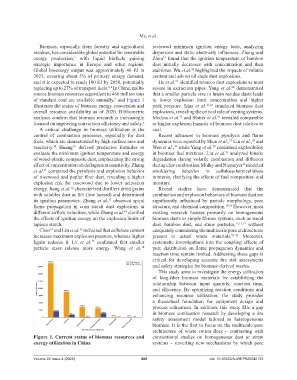
                illustrates the status of biomass energy conversion and   peak  pressure. Islas  et  al. 23,24  simulated  biomass dust
                overall  resource availability  as of 2020. Bibliometric   explosions, revealing the critical role of venting systems.
                analyses confirm that biomass research is increasingly   Medina et al.  and Slatter et al.  revealed comparable
                                                                                                 26
                                                                                25
                focused on improving conversion efficiency and safety. 6  or higher explosion hazards of biomass dust relative to
                  A  critical  challenge  in  biomass  utilization  is  the   coal.
                control  of combustion  processes, especially  for dust   Recent  advances  in  biomass  pyrolysis  and  flame
                fuels, which are characterized by high surface area and   dynamics were reported by Shen et al.,  Liu et al.,  and
                                                                                                                28
                                                                                                      27
                reactivity.  Huang  derived  predictive  formulas to   Wen et al.,  while Yang et al.  confirmed explosibility
                                 10
                         10
                                                                                               30
                                                                              29
                evaluate the minimum ignition temperature and energy   in biomass fuel mixtures. Liu et al.  analyzed kinetic
                                                                                                    31
                of wood-plastic composite dust, emphasizing the strong   degradation  during  volatile  combustion  and  diffusion
                effect of concentration on deflagration sensitivity. Zhang   during char combustion. Mulky and Niemeyer  modeled
                                                                                                            32
                et al.  compared the pyrolysis and explosion behavior   smoldering  behavior  in  cellulose-hemicellulose
                    11
                of rosewood and poplar fiber dust, revealing a higher   mixtures, clarifying the effects of fuel composition and
                explosion  risk  for  rosewood  due  to  lower  activation   moisture.
                energy. Jiang et al.  characterized distillers dried grains   Recent  studies have  demonstrated  that  the
                                12
                with solubles dust as St1 (low hazard) and determined   combustion and explosion behaviors of biomass dust are
                its ignition parameters. Zhang et al.  observed spiral   significantly  influenced  by  particle  morphology,  pore
                                                 13
                flame  propagation  in  corn  starch  dust  explosions  at   structure, and chemical composition. 10-22  However, most
                different airflow velocities, while Zhang et al.  clarified   existing  research focuses primarily  on homogeneous
                                                        14
                the effects of ignition energy on the explosion limits of   biomass dusts or simple fibrous systems, such as wood
                tapioca starch.                                     dust, bamboo  dust, and  straw particles, 11,12,19  without
                  Chen  and Liu et al.  indicated that cellulose content   adequately considering the multiscale pore architectures
                                    16
                       15
                increases maximum explosion pressure, whereas higher   present  in  actual  waste materials. 27-32  Moreover,
                lignin  reduces it.  Lv  et  al.   confirmed  that  smaller   systematic  investigations  into  the  coupling  effects  of
                                         17
                particle  sizes  release  more  energy.  Wang  et  al.    pore  distribution  on  flame  propagation  dynamics  and
                                                               18
                                                                    reaction time remain limited. Addressing these gaps is
                                                                    critical  for  developing  accurate  fire  risk  assessments
                                                                    and safety strategies for biomass-derived wastes.
                                                                       This study aims to investigate the energy utilization
                                                                    of  long-fiber  biomass  materials  by  establishing  the
                                                                    relationship  between  input  quantity,  reaction  time,
                                                                    and efficiency. By optimizing reaction conditions and
                                                                    enhancing  resource  utilization,  the  study  provides
                                                                    a  theoretical  foundation  for  equipment  design  and
                                                                    process  refinement.  In  addition,  this  study  fills  a  gap
                                                                    in  biomass  combustion  research  by  developing  a  fire
                                                                    safety  assessment  model  tailored  to  heterogeneous
                                                                    biomass. It is the first to focus on the multiscale pore
                                                                    architecture  of  waste  cotton  flocs  –  contrasting  with
                Figure 1. Current status of biomass resources and   conventional  studies on homogeneous dust or straw
                energy utilization in China                         systems  –  unveiling  new  mechanisms  by  which  pore


                Volume 22 Issue 4 (2025)                       206                           doi: 10.36922/AJWEP025240193

