


Page 216 - AJWEP-22-4
P. 216
Ma, et al.

                   of CO. Although this process releases comparatively   to cellulose density, was measured as 1.54  g/cm .
                                                                                                                    3
                   less energy, it sustains combustion over an extended   Before experimentation, the flocs were mechanically
                   duration, contributing to prolonged heat output.  processed by cutting into shorter segments and
                  Biomass materials  undergo complex  chemical      aerodynamically disentangled to ensure structural
                reactions  in  the  three  stages  above,  releasing  a   uniformity.
                significant amount of heat. Particularly in the oxidation   2.2. Deflagration test
                stage, the heat is released instantaneously, making it   The deflagration test apparatus comprises a 1 L reaction
                highly susceptible to deflagration.
                                                                    chamber, a high-voltage spark igniter (0.5 kV), a high-
                1.3. Deflagration process                           speed industrial area-array camera (100 frames/s) for
                The deflagration process of cotton floc can be analyzed   observing flame morphology and combustion pressure,
                using experimental data obtained from pipeline testing   a halogen moisture analyzer for measuring the moisture
                and high-speed camera recordings of the complete    content of biomass materials, an electronic balance
                                                                    (precision of 0.0001  g), a Machine  Vision Software
                combustion process. 35-38                           data  acquisition  system,  and  an  experimental  rack
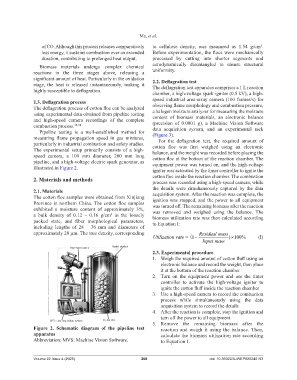
                  Pipeline  testing is a well-established  method for   (Figure 3).
                measuring  flame  propagation  speed  in  gas  mixtures,   For  the  deflagration  test,  the  required  amount  of
                particularly in industrial combustion and safety studies.   cotton  floc  was  first  weighed  using  an  electronic
                The experimental  setup primarily consists of a high-  balance, and the weight was recorded before placing the
                speed  camera,  a  100  mm  diameter, 200  mm  long   cotton floc at the bottom of the reaction chamber. The
                pipeline, and a high-voltage electric spark generator, as   equipment power was turned on, and the high-voltage
                illustrated in Figure 2.                            igniter was activated by the timer controller to ignite the

                2. Materials and methods                            cotton floc inside the reaction chamber. The combustion
                                                                    process was recorded using a high-speed camera, while
                2.1. Materials                                      the details were simultaneously captured by the data
                                                                    acquisition system. After the reaction was complete, the
                The cotton floc samples were obtained from Xinjiang   ignition was stopped, and the power to all equipment
                Province in northern China. The cotton floc samples   was turned off. The remaining biomass after the reaction
                exhibited a moisture content of approximately 3%,   was removed  and  weighed  using the  balance.  The
                a  bulk  density  of  0.12  –  0.16  g/cm  in the loosely   biomass utilization rate was then calculated according
                                                  3
                packed  state,  and  fiber  morphological  parameters,   to Equation I:
                including  lengths  of  28  –  36  mm  and  diameters  of
                approximately 20 μm. The true density, corresponding                     Residual mass
                                                                    Utilizationrate  ̵1             ) 100%      (I)
                                                                                          Input mass

                                                                    2.3. Experimental procedure
                                                                    1.  Weigh the required amount of cotton fluff using an
                                                                        electronic balance and record the weight, then place
                                                                        it at the bottom of the reaction chamber
                                                                    2.  Turn  on  the  equipment  power  and  use  the  timer
                                                                        controller  to activate  the high-voltage  igniter  to
                                                                        ignite the cotton fluff inside the reaction chamber
                                                                    3.  Use a high-speed camera to record the combustion
                                                                        process while simultaneously using the data
                                                                        acquisition system to record the details
                                                                    4.  After the reaction is complete, stop the ignition and
                                                                        turn off the power to all equipment
                                                                    5.  Remove the remaining biomass after the
                Figure  2.  Schematic  diagram of the pipeline  test    reaction and weigh it using the balance. Then,
                apparatus                                               calculate the biomass utilization rate according
                Abbreviation: MVS: Machine Vision Software.             to Equation I.


                Volume 22 Issue 4 (2025)                       208                           doi: 10.36922/AJWEP025240193

