


Page 219 - AJWEP-22-4
P. 219
Porosity-driven biomass combustion

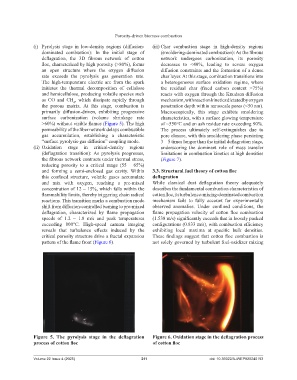
                (i)  Pyrolysis  stage  in  low-density  regions  (diffusion-  (iii) Char  combustion  stage  in  high-density  regions
                   dominated  combustion):  In the  initial  stage  of   (smoldering-dominated combustion): As the fibrous
                   deflagration,  the  3D  fibrous  network  of  cotton   network  undergoes  carbonization,  its  porosity
                   floc, characterized by high porosity (>80%), forms   decreases  to <40%, leading  to  severe  oxygen
                   an  open  structure  where  the  oxygen  diffusion   diffusion constraints and the formation of a dense
                   rate  exceeds  the  pyrolysis  gas  generation  rate.   char layer. At this stage, combustion transitions into
                   The high-temperature electric arc from the spark     a heterogeneous surface oxidation regime, where
                   initiates  the thermal decomposition of cellulose    the  residual  char  (fixed  carbon  content  >75%)
                   and hemicellulose, producing volatile species such   reacts with oxygen through the Knudsen diffusion
                   as CO and CH , which dissipate  rapidly  through     mechanism, with reaction kinetics dictated by oxygen
                                 4
                   the porous matrix.  At this stage, combustion  is    penetration depth within nanoscale pores (<50 nm).
                   primarily  diffusion-driven,  exhibiting  progressive   Macroscopically, this stage exhibits  smoldering
                   surface  carbonization  (volume  shrinkage  rate     characteristics, with a surface glowing temperature
                   >60%) without visible flames (Figure 5). The high    of ~550°C and an ash residue rate exceeding 90%.
                   permeability of the fiber network delays combustible   The  process ultimately  self-extinguishes  due  to
                   gas  accumulation,  establishing  a  characteristic   pore closure, with this smoldering phase persisting
                   “surface pyrolysis-gas diffusion” coupling mode.     3 – 5 times longer than the initial deflagration stage,
                (ii)  Oxidation stage in critical-density  regions      underscoring the dominant  role of mass transfer
                   (deflagration  transition):  As  pyrolysis  progresses,   limitations in combustion kinetics at high densities
                   the fibrous network contracts under thermal stress,   (Figure 7).
                   reducing  porosity  to  a  critical  range  (55  –  65%)
                   and forming a semi-enclosed  gas cavity.  Within   3.3. Structural fuel theory of cotton floc
                   this  confined  structure,  volatile  gases  accumulate   deflagration
                   and mix with oxygen, reaching a pre-mixed        While  classical  dust  deflagration  theory  adequately
                   concentration of 12 – 15%, which falls within the   describes the fundamental combustion characteristics of
                   flammability limits, thereby triggering chain radical   cotton floc, its turbulence-mixing-dominated combustion
                   reactions. This transition marks a combustion mode   mechanism  fails  to  fully  account  for experimentally
                   shift from diffusion-controlled burning to pre-mixed   observed  anomalies.  Under  confined  conditions,  the
                   deflagration,  characterized  by  flame  propagation   flame  propagation  velocity  of  cotton  floc  combustion
                   speeds  of  1.2  –  1.8  m/s  and  peak  temperatures   (1.538 m/s) significantly exceeds that in loosely packed
                   exceeding  800°C.  High-speed  camera  imaging   configurations (0.833 m/s), with combustion efficiency
                   reveals  that  turbulence  effects  induced  by  the   exhibiting  local  maxima  at  specific  bulk  densities.
                   critical porosity structure drive a fractal expansion   These findings suggest that cotton floc combustion is
                   pattern of the flame front (Figure 6).           not solely governed by turbulent fuel-oxidizer mixing


                Figure  5.  The  pyrolysis  stage  in  the  deflagration   Figure 6. Oxidation stage in the deflagration process
                process of cotton floc                              of cotton floc


                Volume 22 Issue 4 (2025)                       211                           doi: 10.36922/AJWEP025240193

