


Page 218 - AJWEP-22-4
P. 218
Ma, et al.
140 kJ/mol; T is the temperature; and R is the universal oxygen availability while facilitating rapid heat
gas constant, 8.314 mol/K. 39 dissipation during combustion, thereby accelerating
In the structure-reaction coupled modification model, flame propagation. Moreover, the fiber surface
the actual reaction rate is limited by diffusion, and can readily adsorbs water vapor and volatile combustible
be expressed as: gases, further increasing its susceptibility to ignition,
particularly under elevated temperatures or static charge
min ̵ ̹ m stoichiometric ratio ̶ (VIII)
actual kinetic O 2 accumulation.
Where m is the maximum oxygen diffusion flux Taken together, the high specific surface area, loose
O 2 and porous structure, low density, and gas adsorption
limited by the pore structure characteristics, and the capacity, coupled with its inherent flammability, render
stoichiometric ratio refers to the mass ratio of oxygen to cotton floc highly susceptible to deflagration under
fuel required for complete combustion. When oxygen certain conditions.
diffusion capacity is inadequate, the reaction rate is
constrained to m times the oxygen requirement per 3.2. Deflagration behavior of elongated fibrous
O 2
unit fuel. biomass
In the deflagration test, 1.3 g of cotton floc was
3. Results and discussion uniformly placed inside the pipeline, with the high-
voltage electric spark generator positioned at the
3.1. Physical structure and combustion behavior of bottom. The high-speed camera recorded the position
elongated fibrous biomass of the flame front over time, and the flame propagation
Biomass materials, such as cotton floc found in speed was calculated based on the flame front’s position
northern China, exhibit high combustibility due to at different time points.
their fibrous composition, high porosity, and low- In the pipeline experiment, under unsealed
density characteristics. Microscopic analysis of cotton conditions, the flame front reached the top cap within
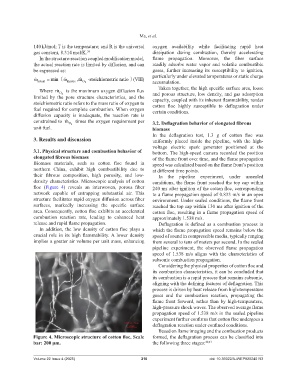
floc (Figure 4) reveals an interwoven, porous fiber 240 ms after ignition of the cotton floc, corresponding
network capable of entrapping substantial air. This to a flame propagation speed of 0.833 m/s in an open
structure facilitates rapid oxygen diffusion across fiber environment. Under sealed conditions, the flame front
surfaces, markedly increasing the specific surface reached the top cap within 130 ms after ignition of the
area. Consequently, cotton floc exhibits an accelerated cotton floc, resulting in a flame propagation speed of
combustion reaction rate, leading to enhanced heat approximately 1.538 m/s.
release and rapid flame propagation. Deflagration is defined as a combustion process in
In addition, the low density of cotton floc plays a which the flame propagation speed remains below the
crucial role in its high flammability. A lower density speed of sound in compressible media, typically ranging
implies a greater air volume per unit mass, enhancing from several to tens of meters per second. In the sealed
pipeline experiment, the observed flame propagation
speed of 1.538 m/s aligns with the characteristics of
subsonic combustion propagation.
Considering the physical properties of cotton floc and
its combustion characteristics, it can be concluded that
its combustion is a rapid process that remains subsonic,
aligning with the defining features of deflagration. This
process is driven by heat release from high-temperature
gases and the combustion reaction, propagating the
flame front forward, rather than by high-temperature,
high-pressure shock waves. The observed average flame
propagation speed of 1.538 m/s in the sealed pipeline
experiment further confirms that cotton floc undergoes a
deflagration reaction under confined conditions.
Based on flame imaging and the combustion products
Figure 4. Microscopic structure of cotton floc. Scale formed, the deflagration process can be classified into
bar: 200 µm. the following three stages: 40,41
Volume 22 Issue 4 (2025) 210 doi: 10.36922/AJWEP025240193

