


Page 222 - AJWEP-22-4
P. 222
Ma, et al.

                porous structure significantly enhances gas-solid mass   reaction duration, and increased fluctuations. However,
                transfer,  facilitating  a  dynamic  equilibrium  between   at  moderate  input  mass (e.g., 0.64  g), a dynamic
                oxygen transport capacity and combustion demand.    equilibrium  is  established  between  oxygen  supply,
                As a result, it sustains combustion stability while   heat  transfer,  and  reactant  diffusion,  enabling  a  more
                maximizing reaction intensity, ultimately achieving an   intense and efficient reaction, with utilization efficiency
                optimized balance between energy density and reaction   reaching a local peak. This phenomenon highlights the
                efficiency.  These  findings  provide  key  experimental   interdependence  of oxygen supply, thermal  transport,
                evidence for the parameter optimization of resource-  and  material  diffusion  within  the  reaction  system,
                efficient combustion systems.                       underscoring that precise control of input mass is
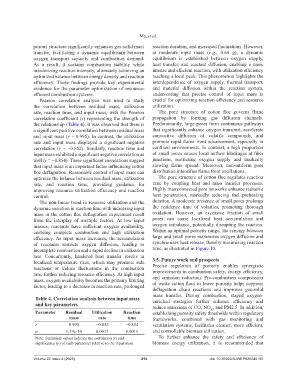
                  Pearson correlation  analysis was used to study   crucial for optimizing reaction efficiency and resource
                the  correlation  between  residual  mass,  utilization   utilization.
                rate,  reaction  time,  and  input  mass,  with  the  Pearson   The  pore  structure  of  cotton  floc  governs  flame
                correlation  coefficient  (r)  representing  the  strength  of   propagation  by  forming  gas  diffusion  channels.
                the relationship (Table 4). It was observed that there is   Predominantly, large pores form continuous pathways
                a significant positive correlation between residual mass   that significantly enhance oxygen transport, accelerate
                and input mass (r = 0.995). In contrast, the utilization   convective  diffusion  of  volatile  compounds,  and
                rate  and  input  mass  displayed  a  significant  negative   promote rapid flame front advancement, especially in
                correlation  (r  =  −0.852).  Similarly,  reaction  time  and   confined environments. In contrast, a high proportion
                input mass exhibited a significant negative correlation as   of small pores causes local airflow blockages at fiber
                well (r = −0.854). These significant correlations suggest   junctions,  restricting  oxygen supply and markedly
                that input mass is an important factor influencing cotton   slowing  flame  spread.  Moreover,  non-uniform  pore
                floc deflagration. Reasonable control of input mass can   distribution intensifies flame front oscillations.
                optimize the balance between residual mass, utilization   The pore structure of cotton floc regulates reaction
                rate,  and  reaction  time,  providing  guidance  for   time by coupling heat and mass transfer processes.
                improving resource utilization efficiency and reaction   Highly interconnected pore networks enhance radiative
                control.                                            heat  penetration,  markedly  reducing  fuel  preheating
                  The non-linear trend in resource utilization and the   duration. A moderate presence of small pores prolongs
                dynamic variation in reaction time with increasing input   the  residence  time  of volatiles,  promoting  thorough
                mass in the cotton floc deflagration experiment result   oxidation.  However, an excessive  fraction  of small
                from the  interplay  of multiple  factors.  At low input   pores  can  cause  localized  heat  accumulation  and
                masses,  reactants  have  sufficient  oxygen  availability,   oxygen imbalance, potentially disrupting the reaction.
                enabling  complete  combustion  and  high  utilization   Within an optimal porosity range, the synergy between
                efficiency. As  input  mass  increases,  the  accumulation   large and small pores maximizes oxygen diffusion and
                of  reactants  restricts  oxygen  diffusion,  leading  to   synchronizes heat release, thereby minimizing reaction
                incomplete combustion and a rapid decline in utilization   time, as illustrated in Figure 10.
                rate. Concurrently, hindered heat transfer results in
                localized  temperature  rises,  which  may  promote  side   3.5. Future work and prospects
                reactions  or  induce  fluctuations  in  the  combustion   Precise regulation of porosity enables  synergistic
                rate, further reducing resource efficiency. At high input   improvements in combustion safety, energy efficiency,
                mass, oxygen availability becomes the primary limiting   and  emission  reduction.  Pre-combustion  compression
                factor, leading to a decrease in reaction rate, prolonged   of waste cotton flocs to lower porosity helps suppress
                                                                    deflagration  chain  reactions  and  improves  gas-solid
                                                                    mass  transfer.  During  combustion,  staged  oxygen-
                 Table 4. Correlation analysis between input mass   enriched  strategies  further  enhance  efficiency  and
                 and key parameters                                 reduce emissions of CO, NO , and PM2.5. In addition,
                                                                                              X
                 Parameter    Residual    Utilization   Reaction    establishing porosity safety thresholds within regulatory
                               mass         rate         time       frameworks,  combined  with  gas monitoring  and
                 r             0.995       −0.852       −0.854      ventilation systems, facilitates cleaner, more efficient,
                 p            1.39e-10     0.0013       0.0011      and controllable biomass utilization.
                 Note: Statistical values indicate the correlation (r) and   To  further  enhance  the  safety  and  efficiency  of
                 significance (p) of each parameter relative to the input mass.  biomass  energy  utilization,  it  is  recommended  that


                Volume 22 Issue 4 (2025)                       214                           doi: 10.36922/AJWEP025240193

