


Page 221 - AJWEP-22-4
P. 221
Porosity-driven biomass combustion

                 Table 3. Input mass of cotton floc and corresponding measurements
                 Input mass (g)  Bulk density (g/m )  Porosity  Residual mass (g)  Utilization rate (%)  Reaction time (s)
                                                3
                 0.08                   80           0.9481         0.0039             95.13               0.55
                 0.16                   160          0.8961         0.0706             55.88               0.49
                 0.24                   240          0.8442         0.1004             58.17               0.40
                 0.32                   320          0.7922         0.2068             35.38               0.38
                 0.40                   400          0.7403         0.2298             42.55               0.39
                 0.48                   480          0.6883         0.3319             30.85               0.34
                 0.56                   560          0.6364         0.4128             26.29               0.31
                 0.64                   640          0.5844         0.4232             33.88               0.32
                 0.72                   720          0.5325         0.5840             18.89               0.32
                 0.80                   800          0.4805         0.6292             21.35               0.22
                 0.88                   880          0.4286         0.7379             16.15               0.37
                 0.96                   960          0.3766         0.7826             18.48               0.13
                 1.04                  1040          0.3247         0.8306             20.13               0.25


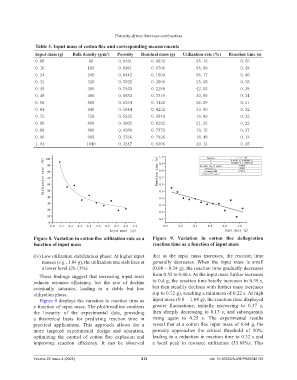
                Figure 8. Variation in cotton floc utilization rate as a   Figure  9.  Variation  in  cotton  floc  deflagration
                function of input mass                              reaction time as a function of input mass

                (iv) Low utilization stabilization phase: At higher input   that as the input mass increases, the reaction time
                   masses (e.g., 1.04 g), the utilization rate stabilizes at   generally decreases.  When the input mass is small
                   a lower level (20.13%).                          (0.08 – 0.24 g), the reaction time gradually decreases

                  These  findings  suggest  that  increasing  input  mass   from 0.55 to 0.40 s. As the input mass further increases
                reduces  resource  efficiency,  but  the  rate  of  decline   to 0.4 g, the reaction time briefly increases to 0.39 s,
                eventually  saturates,  leading to a  stable but  low   but then steadily declines with further mass increases
                utilization phase.                                  (up to 0.72 g), reaching a minimum of 0.22 s. At high
                  Figure 9 displays the variation in reaction time as   input mass (0.8 – 1.04 g), the reaction time displayed
                a function of input mass. The plot/trendline confirms   greater  fluctuations,  initially  increasing  to  0.37  s,
                the linearity of the experimental data, providing   then  sharply  decreasing  to  0.13  s,  and  subsequently
                a theoretical basis for predicting reaction time in   rising again to 0.25 s.  The experimental results
                practical applications.  This approach allows for a   reveal that at a cotton floc input mass of 0.64 g, the
                more targeted experimental design and operation,    porosity approaches the critical threshold of 50%,
                optimizing  the  control  of  cotton  floc  explosion  and   leading to a reduction in reaction time to 0.32 s and
                improving  reaction  efficiency.  It  can  be  observed   a  local  peak  in  resource  utilization  (33.88%).  This


                Volume 22 Issue 4 (2025)                       213                           doi: 10.36922/AJWEP025240193

