


Page 220 - AJWEP-22-4
P. 220
Ma, et al.

                but is instead directly influenced by dynamic porosity   this standard is primarily applicable to different types
                evolution within the fibrous network. 42            of fuels, it serves as a useful reference framework and
                  By integrating porous media combustion theory     methodological guide for this study. The upper explosion
                                                               43
                with fibrous fuel combustion dynamics,  a porosity-  limit  is typically  not considered as a key indicator;
                                                     44
                governed combustion framework is proposed, wherein   rather, it is defined as a certain density, beyond which
                3D fibrous network architectures regulate combustion   explosion  parameters  significantly  decrease.  Table  3
                mode transitions through porosity modulation.       presents the experimental data on cotton floc, including
                This  progression  shifts  from  diffusion-controlled   the input mass and the corresponding reaction time and
                combustion  in  low-density  regimes  to  deflagration   utilization rate.
                in  critical-density  zones,  ultimately  reaching     Figure 8 illustrates the relationship between cotton
                oxygen-starved  combustion  in  high-density  domains   floc input mass and the corresponding utilization rate,
                (ϕ < 40%). This framework advances the understanding   revealing a distinct trend: as the input mass increases,
                of biomass combustion behavior by elucidating       the  utilization  rate  initially  declines  sharply  before
                structural-thermochemical coupling mechanisms and   gradually  reaching  a  stable  value.  This  relationship
                provides  a  foundation  for  optimizing  energy  release   curve can be segmented into several distinct phases:
                efficiency in fibrous biofuels through targeted porosity   (i)  High  utilization  phase:  At  low  input  mass  (e.g.,
                engineering.  The  differences  between  conventional   0.08 g), the utilization rate approaches 1 (95.13%),
                dust deflagration and cotton floc deflagration theories   indicating efficient resource conversion
                are presented in Table 1.                           (ii)  Rapid  decline  phase:  As input  mass increases
                  Table  2  presents  a  comparison  between  the       to  0.16  and  0.24  g,  the  utilization  rate  decreases
                model-predicted  and  experimentally  measured  flame   significantly to 55.88% and 58.17%, respectively
                propagation  speeds  at  a  porosity  (ϕ)  of  35%.  The   (iii) Gradual slowdown phase: From 0.32 g onward, the
                predicted speed was 1.48 m/s, while the experimental    decline in utilization rate moderates, but fluctuations
                value was 1.538 m/s, resulting in an error of 3.9%. This   become  apparent,  with notable  inflection  points
                close agreement validates the accuracy of the predictive   around 0.64 g (33.88%) and 0.88 g (16.15%)
                model  and  supports its  applicability  for  simulating
                flame behavior under similar conditions.             Table 1. Comparative analysis between cotton floc
                                                                     deflagration and conventional dust deflagration
                3.4. Experimental data and analysis                  theories
                Referring to GB/T 16425-2018, “Dust Cloud Explosion
                Lower  Concentration  Determination  Method,”  the   Property      Conventional    Cotton floc
                                                                                   dust deflagration deflagration
                experiment  commenced  with a biomass fuel bulk
                density of 80  g/m ,  with  the  subsequent  increases  in   Oxidant supply  Turbulent   Porosity-guided
                                3
                density  applied  in  fixed-step  increments.  Although   mechanism  stochastic mixing laminar permeation
                                                                     Energy release   Global       Directional
                                                                     mode          homogeneous     combustion wave
                                                                                   reaction        propagation
                                                                     Key control   Dust concentration  Fibrous bulk density
                                                                     parameter     (LEL/UEL)       (porosity, ϕ)
                                                                     Stabilization   Inert gas     Active porosity
                                                                     approach      suppression     modulation
                                                                     Abbreviations: LEL: Lower explosive limit; UEL: Upper
                                                                     explosive limit.
                                                                     Table 2. Flame propagation speed of model
                                                                     prediction versus experimental value
                                                                     Output              Model    Experimental  Error
                                                                                       prediction    value
                                                                     Flame propagation   1.48 m/s   1.538 m/s  3.9%
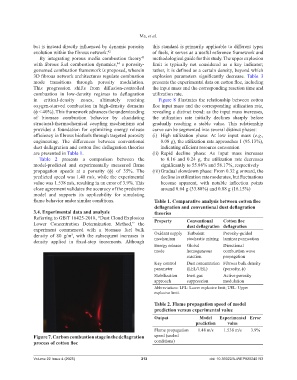
                Figure 7. Carbon combustion stage in the deflagration   speed (sealed
                process of cotton floc                               conditions)


                Volume 22 Issue 4 (2025)                       212                           doi: 10.36922/AJWEP025240193

