


Page 209 - AJWEP-22-4
P. 209
Bombax ceiba-based carbons for dye removal

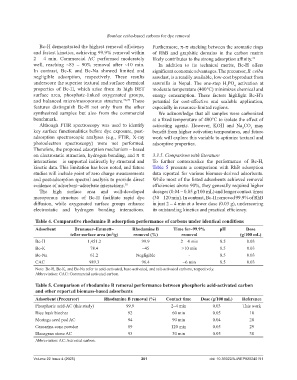
                  Bc-H demonstrated the highest removal efficiency   Furthermore, π–π stacking between the aromatic rings
                and fastest kinetics, achieving 99.9% removal within   of  RhB  and  graphitic domains in the carbon matrix
                2 – 4  min. Commercial  AC performed moderately     likely contributes to the strong adsorption affinity. 31
                well,  reaching  ~85  –  90%  removal  after  ~10  min.   In  addition  to  its  technical  merits,  Bc-H  offers
                In contrast, Bc-K and Bc-Na showed limited and      significant economic advantages. The precursor, B. ceiba
                negligible adsorption, respectively.  These results   sawdust, is a readily available, low-cost byproduct from
                underscore the superior textural and surface chemical   sawmills  in  Nepal.  The  one-step  H PO   activation  at
                                                                                                        4
                                                                                                     3
                properties of Bc-H, which arise from its high BET   moderate temperature (400°C) minimizes chemical and
                surface  area,  phosphate-linked  oxygenated  groups,   energy  consumption.  These  factors  highlight  Bc-H’s
                and balanced micro/mesoporous structure. 28,29  These   potential  for  cost-effective  and  scalable  application,
                features distinguish Bc-H not only from the other   especially in resource-limited regions.
                synthesized samples but also from the commercial       We acknowledge that all samples were carbonized
                benchmark.                                          at a fixed temperature of 400°C to isolate the effect of
                  Although  FTIR  spectroscopy  was  used  to  identify   activating  agents. However, KOH  and Na CO  may
                                                                                                               3
                                                                                                            2
                key surface functionalities before dye exposure, post-  benefit from higher activation temperatures, and future
                adsorption  spectroscopic  analyses  (e.g.,  FTIR,  X-ray   work will explore this variable to optimize textural and
                photoelectron  spectroscopy) were not performed.    adsorptive properties.
                Therefore, the proposed adsorption mechanism – based
                on electrostatic attraction, hydrogen bonding, and π–π   3.3.5. Comparison with literature
                interactions – is supported indirectly by structural and   To further  contextualize  the  performance  of Bc-H,
                kinetic data. This limitation has been noted, and future   Table  5  presents  a  comparison  with  RhB  adsorption
                studies will include point of zero charge measurements   data reported for various biomass-derived adsorbents.
                and post-adsorption spectral analysis to provide direct   While most of the listed adsorbents achieved removal
                evidence of adsorbent–adsorbate interactions. 30    efficiencies above 90%, they generally required higher
                  The high surface area and well-developed          dosages (0.04 – 0.05 g/100 mL) and longer contact times
                mesoporous structure of Bc-H facilitate  rapid dye   (30 – 120 min). In contrast, Bc-H removed 99.9% of RhB
                diffusion,  while  oxygenated  surface  groups  enhance   in just 2 – 4 min at a lower dose (0.03 g), underscoring
                electrostatic  and hydrogen bonding interactions.   its outstanding kinetics and practical efficiency.


                 Table 4. Comparative rhodamine B adsorption performance of carbons under identical conditions
                 Adsorbent        Brunauer–Emmett–         Rhodamine B       Time for~99.9%       pH         Dose
                                teller surface area (m /g)  removal (%)          removal                   (g/100 mL)
                                                  2
                 Bc-H                   1,451.2                99.9              2 – 4 min        8.5         0.03
                 Bc-K                    78.4                   ~45              >10 min          8.5         0.03
                 Bc-Na                   61.2                Negligible             -             8.5         0.03
                 CAC                    989.3                  96.4               ~6 min          8.5         0.03
                 Note: Bc-H, Bc-K, and Bc-Na refer to acid-activated, base-activated, and salt-activated carbons, respectively.
                 Abbreviation: CAC: Commercial activated carbon.

                 Table 5. Comparison of rhodamine B removal performance between phosphoric acid-activated carbon
                 and other reported biomass-based adsorbents
                 Adsorbent (Precursor)         Rhodamine B removal (%)    Contact time   Dose (g/100 mL)    Reference
                 Phosphoric acid-AC (this study)         99.9               2–4 min            0.03         This work
                 Rice husk biochar                       92                  60 min            0.05            10
                 Moringa seed pod AC                     94                  90 min            0.04            28
                 Casuarina cone powder                   89                 120 min            0.05            29
                 Elaeagnus stone AC                      93                  30 min            0.05            30
                 Abbreviation: AC: Activated carbon.


                Volume 22 Issue 4 (2025)                       201                           doi: 10.36922/AJWEP025240191

