


Page 206 - AJWEP-22-4
P. 206
Shrestha

                   adsorption orientation, mobility, and affinity toward
                   charged surfaces. In addition, changes in polarity
                   may  influence  the  extent  of  self-aggregation  in
                   solution.
                   At very high pH (above 10), aggregation, micelle-
                   like  behavior,  or  partial  precipitation  may  occur
                   due to reduced  solubility, which lowers the
                   concentration of freely available dye molecules for
                   adsorption.  Excess hydroxide ions (OH⁻) may also
                             16
                   compete with RhB for active adsorption sites on the
                   adsorbent surface.
                   In terms of surface charges, the surface charge of
                   Bc-H is primarily  governed by the protonation
                   and deprotonation of its surface functional groups,
                   particularly –OH, –COOH, and –C=O, introduced
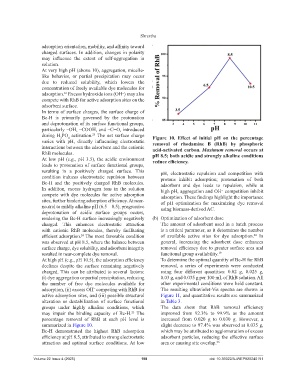
                   during H PO  activation.  The net surface charge   Figure  10.  Effect  of  initial  pH  on  the  percentage
                                          23
                               4
                            3
                   varies  with  pH,  directly  influencing  electrostatic   removal of rhodamine B (RhB)  by  phosphoric
                   interactions between the adsorbent and the cationic   acid-activated carbon. Maximum removal occurs at
                   RhB molecules.                                   pH 8.5; both acidic and strongly alkaline conditions
                   At low pH (e.g., pH 3.5), the acidic environment   reduce efficiency.
                   leads to protonation of surface functional groups,
                   resulting  in  a  positively  charged  surface.  This   pH, electrostatic  repulsion and competition  with
                   condition  induces  electrostatic  repulsion  between   protons  inhibit  adsorption;  protonation  of  both
                   Bc-H  and  the  positively  charged  RhB  molecules.   adsorbent and dye leads to repulsion, while at
                   In addition, excess hydrogen ions in the solution    high pH, aggregation and OH⁻ competition inhibit
                   compete with dye molecules for active adsorption     adsorption. These findings highlight the importance
                   sites, further hindering adsorption efficiency. At near-  of pH optimization  for maximizing  dye removal
                   neutral to mildly alkaline pH (6.5 – 8.5), progressive   using biomass-derived AC.
                   deprotonation of acidic surface groups occurs,
                   rendering the Bc-H surface increasingly negatively   (b)  Optimization of adsorbent dose
                   charged.  This enhances electrostatic attraction      The amount of adsorbent used in a batch process
                   with  cationic  RhB  molecules,  thereby  facilitating   is a critical parameter, as it determines the number
                   efficient adsorption.  The most favorable condition   of available  active  sites for dye adsorption.  In
                                     24
                                                                                                                 24
                   was observed at pH 8.5, where the balance between    general, increasing  the adsorbent dose enhances
                   surface charge, dye solubility, and adsorbent integrity   removal efficiency due to greater surface area and
                   resulted in near-complete dye removal.               functional group availability. 19
                   At high pH (e.g., pH 10.5), the adsorption efficiency      To determine the optimal quantity of Bc-H for RhB
                   declines  despite  the  surface  remaining  negatively   removal,  a series of experiments  were conducted
                   charged. This can be attributed to several factors:   using  four  different  quantities:  0.02  g,  0.025  g,
                   (i) dye aggregation or partial precipitation, reducing   0.03 g, and 0.035 g per 100 mL of RhB solution. All
                   the number of free dye molecules  available  for     other experimental conditions were held constant.
                   adsorption, (ii) excess OH⁻ competing with RhB for   The resulting ultraviolet-Vis spectra are shown in
                   active adsorption sites, and (iii) possible structural   Figure 11, and quantitative results are summarized
                   alteration  or destabilization  of surface functional   in Table 3.
                   groups under highly alkaline  conditions,  which      The  data  show  that  RhB  removal  efficiency
                   may  impair  the binding  capacity  of Bc-H.  The    improved from 92.3% to 99.9% as the amount
                                                           25
                   percentage  removal  of  RhB  at  each  pH  level  is   increased  from 0.020  g to 0.030  g. However, a
                   summarized in Figure 10.                             slight decrease to 97.4% was observed at 0.035 g,
                   Bc-H  demonstrated  the  highest  RhB  adsorption    which may be attributed to agglomeration of excess
                   efficiency at pH 8.5, attributed to strong electrostatic   adsorbent particles, reducing the effective surface
                   attraction  and  optimal  surface  conditions. At low   area or causing site overlap. 26


                Volume 22 Issue 4 (2025)                       198                           doi: 10.36922/AJWEP025240191

