


Page 202 - AJWEP-22-4
P. 202
Shrestha

                most developed and uniform mesoporous structure,
                attributed  to  the  efficient  activating  effect  of  H PO 4
                                                            3
                at  400°C.  In  contrast,  Bc-K  and  Bc-Na  exhibited
                suboptimal activation, with denser or irregular surfaces
                due to insufficient thermal conditions for their respective
                activating  chemistries.  These  morphological  trends
                are  consistent  with BET surface  areas and structural
                disorder observed through Raman and XRD, reinforcing
                the superior activation achieved in Bc-H.
                  While SEM revealed the general surface morphology,
                higher-resolution  imaging  (e.g., transmission electron
                microscopy) could further elucidate  nanostructural
                features and will be considered in future studies.

                3.2.4. Nitrogen adsorption/desorption isotherm and
                BET surface area analysis
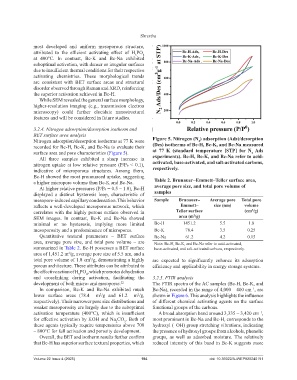
                Nitrogen adsorption/desorption isotherms at 77 K were   Figure 5. Nitrogen (N ) adsorption (Ads)/desorption
                                                                                        2
                recorded for Bc-H, Bc-K, and Bc-Na to evaluate their   (Des) isotherms of Bc-H, Bc-K, and Bc-Na measured
                surface area and pore characteristics (Figure 5).   at 77 K (standard temperature [STP] for N  Ads
                                                                                                                2
                  All  three  samples  exhibited  a sharp increase  in   experiments). Bc-H, Bc-K, and Bc-Na refer to acid-
                nitrogen uptake at low  relative pressure  (P/P₀  <  0.1),   activated, base-activated, and salt-activated carbons,
                indicative  of microporous  structures.  Among them,   respectively.
                Bc-H showed the most pronounced uptake, suggesting
                a higher micropore volume than Bc-K and Bc-Na.       Table 2. Brunauer–Emmett–Teller surface area,
                  At higher relative pressures (P/P₀ = 0.5 – 1.0), Bc-H   average pore size, and total pore volume of
                displayed a distinct hysteresis loop, characteristic  of   samples
                mesopore-induced capillary condensation. This behavior   Sample  Brunauer–   Average pore   Total pore
                reflects a well-developed mesoporous network, which             Emmett–        size (nm)     volume
                                                                                                                3
                correlates with the highly porous surface observed in          Teller surface                (cm /g)
                                                                                      2
                SEM images. In contrast, Bc-K and Bc-Na showed                  area (m /g)
                minimal  or no hysteresis, implying  more  limited   Bc-H         1451.2          5.5         1.8
                mesoporosity and a predominance of micropores.       Bc-K          78.4           3.5         0.25
                  Quantitative textural parameters – BET surface     Bc-Na         61.2           4.2         0.15
                area, average pore size, and total pore volume – are   Note: Bc-H, Bc-K, and Bc-Na refer to acid-activated,
                summarized in Table 2. Bc-H possesses a BET surface   base-activated, and salt-activated carbons, respectively.
                area of 1,451.2 m /g, average pore size of 5.5 nm, and a
                               2
                total pore volume of 1.8 cm /g, demonstrating a highly   are  expected  to  significantly  enhance  its  adsorption
                                         3
                porous architecture. These attributes can be attributed to   efficiency and applicability in energy storage systems.
                the effective action of H PO , which promotes dehydration
                                   3
                                       4
                and crosslinking during activation, facilitating the   3.2.5. FTIR analysis
                development of both micro- and mesopores. 22        The FTIR spectra of the AC samples (Bc-H, Bc-K, and
                  In comparison, Bc-K and Bc-Na exhibited  much     Bc-Na), recorded in the range of 4,000 – 400 cm , are
                                                                                                                −1
                lower surface areas (78.4  m /g and 61.2  m /g,     shown in Figure 6. This analysis highlights the influence
                                             2
                                                              2
                respectively). Their narrower pore size distributions and   of different chemical activating agents on the surface
                weaker mesoporosity are largely due to the suboptimal   functional groups of the carbons.
                activation  temperature  (400°C),  which  is  insufficient   A broad absorption band around 3,335 – 3,420 cm ,
                                                                                                                   −1
                for effective activation by KOH and Na CO . Both of   most prominent in Bc-Na and Bc-H, corresponds to the
                                                    2
                                                        3
                these agents typically require temperatures above 700   hydroxyl (–OH) group stretching vibrations, indicating
                – 800°C for full activation and porosity development.  the presence of hydroxyl groups from alcohols, phenolic
                  Overall, the BET and isotherm results further confirm   groups,  as well as adsorbed moisture.  The relatively
                that Bc-H has superior surface textural properties, which   reduced intensity of this band in Bc-K suggests more


                Volume 22 Issue 4 (2025)                       194                           doi: 10.36922/AJWEP025240191

