


Page 199 - AJWEP-22-4
P. 199
Bombax ceiba-based carbons for dye removal

                Corporation,  USA) after  degassing the  samples  at    150 °C due to the evaporation of physically adsorbed
                300°C  for  6  h  under  vacuum  to  determine  specific   water. This is associated with a mild endothermic
                surface area, pore volume, and average pore diameter.   dip in the DSC curve, reflecting energy absorption
                These parameters  were used to assess the adsorption    during moisture loss.
                potential of each sample.                           (ii)  Active pyrolysis phase (~200 – 400°C): The major
                                                                        decomposition phase occurred between 200°C and
                2.4.7. Adsorption evaluation                            400°C,  accounting  for  a  ~60%  mass  loss.  This
                Adsorption  performance   was    evaluated  using       corresponds to the  breakdown of hemicellulose
                ultraviolet-Vis  spectrophotometry  (SCINCO Mega-       (200 – 300°C) and cellulose (300 – 400°C).  The
                                                                                                                11
                2100, double beam at 554 nm with a 1 cm quartz          strong exothermic peak in the DSC curve indicates
                cuvette; SCINCO Co., Ltd., South Korea) by monitoring   significant heat release during pyrolytic degradation
                RhB concentration changes during batch experiments.     and volatile matter evolution.
                Absorbance data  were used to  calculate  dye removal   (iii) Optimal  carbonization  zone  (~400°C):  Around
                percentages under various conditions.                   400°C,  a  sharp  decline  in  the TGA  curve  and  an
                                                                        intense exothermic peak in the DSC profile signaled
                3. Results and discussion                               the completion of cellulose degradation and the onset
                                                                        of lignin breakdown.  This temperature marks the
                                                                                          10
                3.1. Thermal degradation of B. ceiba wood powder        transition from volatile release to the formation of a
                TGA and DSC were performed on raw B. ceiba wood         carbon-rich matrix. Therefore, 400°C was selected
                powder to investigate its thermal decomposition profile   as the carbonization temperature, offering a balance
                and determine the optimal carbonization temperature.    between carbon yield and structural stability.
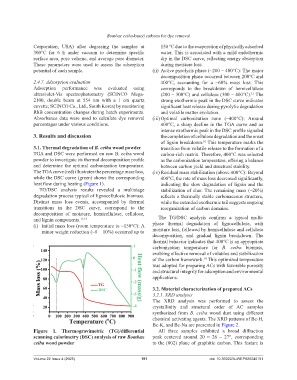
                The TGA curve (red) illustrates the percentage mass loss,   (iv) Residual mass stabilization (above 400°C): Beyond
                while the DSC curve (green) shows the corresponding     400°C, the rate of mass loss decreased significantly,
                heat flow during heating (Figure 1).                    indicating  the slow degradation of lignin and the
                  TG/DSC analysis results revealed  a multistage        stabilization of char. The remaining mass (~20%)
                degradation process typical of lignocellulosic biomass.   reflects a thermally stable carbonaceous structure,
                Distinct mass loss  events, accompanied  by thermal     while the extended exothermic tail suggests ongoing
                transitions in the DSC curve, correspond to the         reorganization of carbon domains.
                decomposition  of moisture, hemicellulose,  cellulose,
                and lignin components. 11,13                           The  TG/DSC  analysis  confirms  a  typical  multi-
                (i)  Initial mass loss (room temperature to ~150°C): A   phase thermal degradation  of lignocellulose,  with
                   minor weight reduction (~8 – 10%) occurred up to   moisture loss, followed by hemicellulose and cellulose
                                                                    decomposition,  and  gradual  lignin  breakdown.  The
                                                                    thermal behavior indicates that 400°C is an appropriate
                                                                    carbonization  temperature  for  B. ceiba biomass,
                                                                    enabling effective removal of volatiles and stabilization
                                                                    of the carbon framework.  This optimized temperature
                                                                                           14
                                                                    was adopted for preparing ACs with favorable porosity
                                                                    and structural integrity for adsorption and environmental
                                                                    applications.

                                                                    3.2. Material characterization of prepared ACs
                                                                    3.2.1. XRD analysis
                                                                    The  XRD  analysis  was  performed  to  assess  the
                                                                    crystallinity  and structural order of  AC samples
                                                                    synthesized  from  B.  ceiba  wood  dust  using  different
                                                                    chemical activating agents. The XRD patterns of Bc-H,
                                                                    Bc-K, and Bc-Na are presented in Figure 2.
                Figure  1.  Thermogravimetric  (TG)/differential       All  three  samples  exhibited  a  broad  diffraction
                scanning calorimetry (DSC) analysis of raw Bombax   peak centered  around 2θ  ≈  26  –  27°,  corresponding
                ceiba wood powder                                   to the (002) plane of graphitic carbon. This feature is


                Volume 22 Issue 4 (2025)                       191                           doi: 10.36922/AJWEP025240191

