


Page 200 - AJWEP-22-4
P. 200
Shrestha

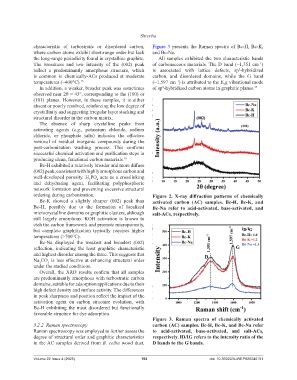
                characteristic  of turbostratic or disordered carbon,   Figure  3  presents  the  Raman  spectra  of  Bc-H,  Bc-K,
                where carbon atoms exhibit short-range order but lack   and Bc-Na.
                the long-range periodicity found in crystalline graphite.   All samples exhibited the two characteristic bands
                The broadness and low intensity  of the (002) peak   of carbonaceous materials. The D band (~1,351 cm )
                                                                                                                   −1
                reflect  a  predominantly  amorphous  structure,  which   is  associated  with  lattice  defects,  sp -hybridized
                                                                                                          3
                is common in  chemically-ACs  produced  at  moderate   carbon, and disordered domains, while the G band
                temperatures (~400°C). 15                           (~1,597 cm ) is attributed to the E g vibrational mode
                                                                              −1
                                                                                                   2
                  In addition, a weaker, broader peak was sometimes   of sp -hybridized carbon atoms in graphitic planes. 17
                                                                         2
                observed near 2θ ≈ 43°, corresponding to the (100) or
                (101) planes. However, in these samples, it is either
                absent or poorly resolved, reinforcing the low degree of
                crystallinity and suggesting irregular layer stacking and
                structural disorder in the carbon matrix.
                  The absence of sharp crystalline  peaks from
                activating  agents (e.g., potassium chloride,  sodium
                chloride,  or  phosphate  salts)  indicates  the  effective
                removal  of residual inorganic compounds during the
                post-carbonization  washing  process.  This  confirms
                successful chemical activation and purification steps in
                producing clean, functional carbon materials. 16
                  Bc-H exhibited a relatively broader and more diffuse
                (002) peak, consistent with highly amorphous carbon and
                well-developed porosity. H PO  acts as a crosslinking
                                            4
                                        3
                and  dehydrating  agent,  facilitating  polyphosphoric
                network formation and preventing excessive structural
                ordering during carbonization.                      Figure  2.  X-ray  diffraction  patterns  of  chemically
                  Bc-K showed a slightly  sharper (002) peak than   activated carbon (AC)  samples. Bc-H, Bc-K, and
                Bc-H, possibly due to the formation  of localized   Bc-Na refer to acid-activated,  base-activated, and
                microcrystalline domains or graphitic clusters, although   salt-ACs, respectively.
                still largely amorphous. KOH activation  is known to
                etch the carbon framework and promote microporosity,
                but complete  graphitization  typically  requires higher
                temperatures (>700°C).
                  Bc-Na displayed  the  weakest  and broadest  (002)
                reflection,  indicating  the  least  graphitic  characteristic
                and highest disorder among the three. This suggests that
                Na CO  is less effective at enhancing structural order
                  2
                      3
                under the studied conditions.
                  Overall,  the  XRD  results  confirm  that  all  samples
                are predominantly amorphous with turbostratic carbon
                domains, suitable for adsorption applications due to their
                high defect density and surface activity. The differences
                in peak sharpness and position reflect the impact of the
                activation  agent on carbon structure evolution, with
                Bc-H exhibiting  the  most disordered  but functionally
                favorable structure for dye adsorption.
                                                                    Figure  3. Raman  spectra of chemically activated
                3.2.2. Raman spectroscopy                           carbon (AC) samples. Bc-H, Bc-K, and Bc-Na refer
                Raman spectroscopy was employed to further assess the   to acid-activated, base-activated, and salt-ACs,
                degree of structural order and graphitic characteristics   respectively. ID/IG refers to the intensity ratio of the
                in the AC samples derived from B. ceiba wood dust.   D bands to the G bands.


                Volume 22 Issue 4 (2025)                       192                           doi: 10.36922/AJWEP025240191

