


Page 198 - AJWEP-22-4
P. 198
Shrestha

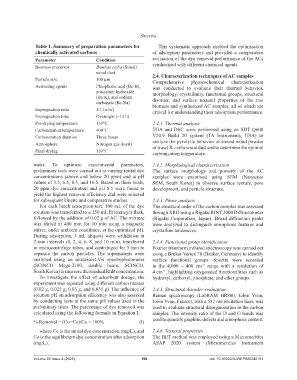
                 Table 1. Summary of preparation parameters for        This systematic approach enabled the optimization
                 chemically activated carbons                       of adsorption parameters and provided a comparative

                 Parameter                 Condition                evaluation of the dye removal performance of the ACs
                 Biomass precursor         Bombax ceiba (Simal)     synthesized with different chemical agents.
                                           wood dust
                 Particle size             100 µm                   2.4. Characterization techniques of AC samples
                                                                                                       characterization
                                                                                     physicochemical
                                                                    Comprehensive
                 Activating agents         Phosphoric acid (Bc-H),   was conducted  to  evaluate  their  thermal  behavior,
                                           potassium hydroxide      morphology, crystallinity, functional groups, structural
                                           (Bc-K), and sodium
                                           carbonate (Bc-Na)        disorder, and surface textural  properties of the raw
                 Impregnation ratio        1:1 (w/w)                biomass and synthesized AC samples, all of which are
                                                                    critical for understanding their adsorption performance.
                 Impregnation time         Overnight (~12 h)
                 Pre-drying temperature    110°C                    2.4.1. Thermal analysis
                 Carbonization temperature  400°C                   TGA and DSC were performed  using an SDT Q600
                 Carbonization duration    Three hours              V20.9 Build  20  system  (TA  Instruments,  USA) to
                 Atmosphere                Nitrogen gas (inert)     analyze the pyrolytic behavior of sieved wood powder
                 Final drying              110°C                    of (raw) B. ceiba wood dust and to determine the optimal
                                                                    carbonization temperature.

                water.  To   optimize   experimental  parameters,   2.4.2. Morphological characterization
                preliminary tests were carried out at varying initial dye   The  surface  morphology and porosity of the  AC
                concentrations  (above and below 20 ppm) and at pH   samples were examined  using SEM (Nanoeyes
                values of 3.5, 6.5, 8.5, and 10.5. Based on these trials,   SEM, South  Korea) to observe surface texture,  pore
                20 ppm dye concentration and pH 8.5 were found to   development, and particle structure.
                yield the highest removal efficiency and were selected
                for subsequent kinetic and comparative studies.     2.4.3. Phase analysis
                  For each batch adsorption test, 100 mL of the dye   The structural order of the carbon samples was assessed
                solution was transferred to a 250 mL Erlenmeyer flask,   through XRD using a Rigaku RINT 2000 Diffractometer
                followed by the addition of 0.02 g of AC. The mixture   (Rigaku  Corporation,  Japan).  Broad  diffraction  peaks
                was stirred at 400  rpm for 10  min using a magnetic   were analyzed to distinguish amorphous features and
                stirrer, under ambient conditions, at the optimized pH.   crystalline tendencies.
                During adsorption, 3 mL aliquots were withdrawn at
                2-min intervals (0, 2, 4, 6, 8, and 10 min), transferred   2.4.4. Functional group identification
                to microcentrifuge tubes, and centrifuged for 5 min to   Fourier transform infrared spectroscopy was carried out
                separate  the carbon particles.  The supernatants  were   using a Bruker Vertex 70 (Bruker, Germany) to identify
                analyzed  using an ultraviolet-Vis spectrophotometer   surface  functional  groups. Spectra  were recorded
                (SCINCO Mega-2100, double beam, SCINCO,             in  the  4,000  –  400  cm   range  with  a  resolution  of
                                                                                          −1
                South Korea) to measure the residual RhB concentration.  4 cm , highlighting oxygenated functionalities such as
                                                                         −1
                  To  investigate  the  effect  of  adsorbent  dosage,  the   hydroxyl, carboxyl, phosphate, and ether groups.
                experiment was repeated using different carbon masses
                (0.02 g, 0.025 g, 0.03 g, and 0.035 g). The influence of   2.4.5. Structural disorder evaluation
                solution pH on adsorption efficiency was also assessed   Raman  spectroscopy  (LabRAM  HR800,  Jobin  Yvon,
                by conducting tests at the same pH values used in the   Jobin Yvon, France), with a 532 nm excitation laser, was
                preliminary trials. The percentage of dye removed was   used to evaluate structural disorganization in the carbon
                calculated using the following formula in Equation I:  samples. The intensity ratio of the D and G bands was
                % Removal = (Co−Ce)/Co × 100%                 (I)   used to quantify graphitic defects and amorphous content.

                  where Co is the initial dye concentration (mg/L), and   2.4.6. Textural properties
                Ce is the equilibrium dye concentration after adsorption   The BET method was employed using a Micromeritics
                (mg/L).                                             ASAP 2020 system (Micromeritics  Instrument


                Volume 22 Issue 4 (2025)                       190                           doi: 10.36922/AJWEP025240191

