


Page 201 - AJWEP-22-4
P. 201
Bombax ceiba-based carbons for dye removal

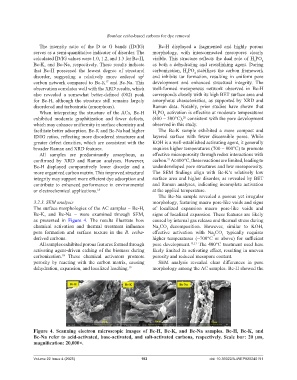
                  The intensity ratio of the D to G bands (ID/IG)      Bc-H displayed a fragmented  and highly porous
                serves as a semi-quantitative indicator of disorder. The   morphology, with interconnected  mesopores clearly
                calculated ID/IG values were 1.0, 1.2, and 1.3 for Bc-H,   visible. This structure reflects the dual role of H PO
                                                                                                                    4
                                                                                                                 3
                Bc-K, and Bc-Na, respectively. These results indicate   as both a dehydrating and crosslinking agent. During
                that  Bc-H possessed the  lowest  degree  of  structural   carbonization,  H PO stabilizes  the  carbon  framework
                                                                                       4
                                                                                   3
                disorder, suggesting  a  relatively  more  ordered  sp    and  inhibits  tar  formation,  resulting  in  uniform  pore
                                                                2
                carbon network compared to Bc-K  and Bc-Na. This    development  and enhanced  structural  integrity.  The
                                               17
                observation correlates well with the XRD results, which   well-formed  mesoporous network observed in Bc-H
                also  revealed  a  somewhat  better-defined  (002)  peak   corresponds closely with its high BET surface area and
                for Bc-H, although  the  structure  still  remains  largely   amorphous  characteristics,  as  supported  by  XRD  and
                disordered and turbostratic (amorphous).            Raman  data.  Notably,  prior  studies  have  shown  that
                  When  interpreting  the  structure  of the ACs, Bc-H   H PO  activation is effective at moderate temperatures
                                                                         4
                                                                      3
                exhibited  moderate  graphitization  and fewer defects,   (400 – 500°C),  consistent with the pore development
                                                                                  20
                which may enhance uniformity in surface chemistry and   observed in this study.
                facilitate better adsorption. Bc-K and Bc-Na had higher   The  Bc-K sample  exhibited  a  more  compact  and
                ID/IG ratios, reflecting more disordered structures and   layered  surface with fewer discernible  pores.  While
                greater defect densities, which are consistent with the   KOH is a well-established activating agent, it generally
                broader Raman and XRD features.                     requires higher temperatures (700 – 800°C) to promote
                  All samples are predominantly  amorphous, as      effective microporosity through redox interactions with
                confirmed  by  XRD  and  Raman  analyses.  However,   carbon.  At 400°C, these reactions are limited, leading to
                                                                           21
                Bc-H displayed  comparatively  lower disorder and a   underdeveloped pore structures and low mesoporosity.
                more organized carbon matrix. This improved structural   The  SEM  findings  align  with  Bc-K’s  relatively  low
                integrity may support more efficient dye adsorption and   surface area and higher disorder, as revealed by BET
                contribute to enhanced performance in environmental   and Raman analyses, indicating incomplete activation
                or electrochemical applications. 18                 at the applied temperature.
                                                                       The Bc-Na sample revealed a porous yet irregular
                3.2.3. SEM analysis                                 morphology, featuring macro pore-like voids and signs
                The surface morphologies of the AC samples – Bc-H,   of localized  expansion macro pore-like voids and
                Bc-K, and Bc-Na – were examined  through SEM,       signs of localized expansion. These features are likely
                as presented  in  Figure  4.  The results illustrate  how   caused by internal gas release and thermal stress during
                chemical  activation  and  thermal  treatment  influence   Na CO decomposition.  However, similar  to KOH,
                                                                          3
                                                                       2
                pore formation  and surface texture  in the  B. ceiba-  effective  activation  with  Na CO  typically  requires
                                                                                               2
                                                                                                   3
                derived carbons.                                    higher  temperatures  (~700°C  or  above)  for  sufficient
                  All samples exhibited porous features formed through   pore development. 13,21  The 400°C treatment used here
                activating agent-driven etching of the biomass during   likely limited its activating effect, resulting in uneven
                carbonization.   These chemical  activators promote   porosity and reduced mesopore content.
                            18
                porosity by reacting  with the carbon matrix,  causing   SEM  analysis  revealed  clear  differences  in  pore
                dehydration, expansion, and localized leaching. 19  morphology among the AC samples. Bc-H showed the


                Figure  4. Scanning electron microscopic  images  of Bc-H,  Bc-K,  and Bc-Na samples. Bc-H,  Bc-K,  and
                Bc-Na refer to acid-activated, base-activated, and salt-activated carbons, respectively. Scale bar: 20  µm,
                magnification: 20,000×.


                Volume 22 Issue 4 (2025)                       193                           doi: 10.36922/AJWEP025240191

