


Page 204 - AJWEP-22-4
P. 204
Shrestha

                3.3.1. Comparative performance of chemically-ACs    exceeded the performance of commercial AC, making
                and commercially-AC                                 it a strong candidate for practical wastewater treatment
                Before analyzing parameter-specific adsorption trends,   applications.
                a baseline  performance  of the three  synthesized     Based on these outcomes,  subsequent detailed
                carbons under fixed conditions (20 ppm RhB, pH 8.5,   adsorption studies – focusing on pH, dosage, and
                0.03 g adsorbent)  was determined.  The  ultraviolet-  contact time – were carried out exclusively for Bc-H.
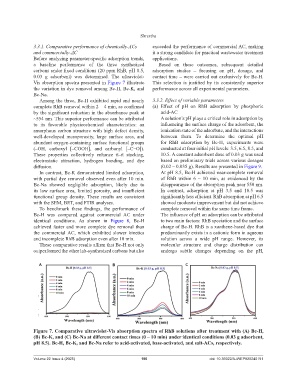
                Vis absorption spectra presented in Figure 7 illustrate   This  selection  is  justified  by  its  consistently  superior
                the variation in dye removal among Bc-H, Bc-K, and   performance across all experimental parameters.
                Bc-Na.
                  Among the three, Bc-H exhibited rapid and nearly   3.3.2. Effect of variable parameters
                complete RhB removal within 2 – 4 min, as confirmed   (a)  Effect  of  pH  on  RhB  adsorption  by  phosphoric
                by the significant reduction in the absorbance peak at   acid-AC
                ~554 nm. This superior performance can be attributed      A solution’s pH plays a critical role in adsorption by
                to  its favorable  physicochemical  characteristics:  an   influencing the surface charge of the adsorbent, the
                amorphous carbon structure  with high defect  density,   ionization state of the adsorbate, and the interactions
                well-developed  mesoporosity,  large  surface  area,  and   between  them.  To determine  the optimal  pH
                abundant oxygen-containing surface functional groups    for  RhB  adsorption  by  Bc-H,  experiments  were
                (–OH,  carboxyl  [–COOH],  and  carbonyl  [–C=O]).      conducted at four initial pH levels: 3.5, 6.5, 8.5, and
                These properties collectively enhance  π–π stacking,    10.5. A constant adsorbent dose of 0.03 g was used
                electrostatic  attraction,  hydrogen bonding, and dye   based on preliminary trials across various dosages
                diffusion.                                              (0.02 – 0.035 g). Results are presented in Figure 9.
                  In contrast, Bc-K demonstrated limited adsorption,      At pH 8.5, Bc-H achieved near-complete removal
                with partial dye removal observed even after 10 min.    of  RhB  within  6  –  10  min,  as  evidenced  by  the
                Bc-Na showed negligible  adsorption, likely due to      disappearance of the absorption peak near 550 nm.
                its low surface area, limited porosity, and insufficient   In contrast, adsorption at pH  3.5 and 10.5 was
                functional  group density.  These results are consistent   significantly less efficient. RhB absorption at pH 6.5
                with the SEM, BET, and FTIR analyses.                   showed moderate improvement but did not achieve
                  To  benchmark  these  findings,  the  performance  of   complete removal within the same time frame.
                Bc-H was compared against commercial  AC under          The influence of pH on adsorption can be attributed
                identical  conditions.  As shown in  Figure  8, Bc-H    to two main factors: RhB speciation and the surface
                achieved faster and more complete dye removal than      charge of Bc-H. RhB is a xanthene-based dye that
                the  commercial AC, which exhibited  slower kinetics    predominantly exists in a cationic form in aqueous
                and incomplete RhB adsorption even after 10 min.        solution across a wide pH range. However, its
                  These comparative results affirm that Bc-H not only   molecular  structure  and charge distribution  can
                outperformed the other lab-synthesized carbons but also   undergo  subtle  changes  depending  on  the  pH,


                  A                                B                               C


                Figure 7. Comparative ultraviolet-Vis absorption spectra of RhB solutions after treatment with (A) Bc-H,
                (B) Bc-K, and (C) Bc-Na at different contact times (0 – 10 min) under identical conditions (0.03 g adsorbent,
                pH 8.5). Bc-H, Bc-K, and Bc-Na refer to acid-activated, base-activated, and salt-ACs, respectively.


                Volume 22 Issue 4 (2025)                       196                           doi: 10.36922/AJWEP025240191

