


Page 207 - AJWEP-22-4
P. 207
Bombax ceiba-based carbons for dye removal


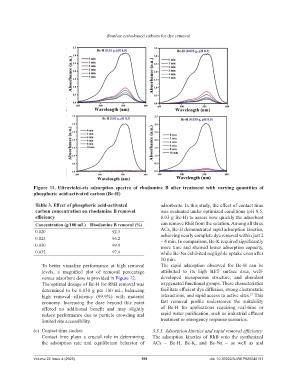
                Figure  11. Ultraviolet-vis  adsorption spectra of rhodamine B after treatment with varying quantities of
                phosphoric acid-activated carbon (Bc-H)

                 Table 3. Effect of phosphoric acid-activated           adsorbents. In this study, the effect of contact time
                 carbon concentration on rhodamine B removal            was evaluated under optimized conditions (pH 8.5,
                 efficiency                                             0.03 g Bc-H) to assess how quickly the adsorbent

                 Concentration (g/100 mL) Rhodamine B removal (%)       can remove RhB from the solution. Among all three
                 0.020                            92.3                  ACs, Bc-H demonstrated rapid adsorption kinetics,
                 0.025                            96.2                  achieving nearly complete dye removal within just 2
                                                                        – 4 min. In comparison, Bc-K required significantly
                 0.030                            99.9                  more time and showed lower adsorption capacity,
                 0.035                            97.4                  while Bc-Na exhibited negligible uptake even after
                                                                        10 min.
                   To  better  visualize  performance  at  high  removal      The rapid adsorption observed for Bc-H can be
                   levels,  a  magnified  plot  of  removal  percentage   attributed  to its high BET surface area, well-
                   versus adsorbent dose is provided in Figure 12.      developed  mesoporous structure,  and  abundant
                   The optimal dosage of Bc-H for RhB removal was       oxygenated functional groups. These characteristics
                   determined  to be 0.030 g per 100 mL,  balancing     facilitate efficient dye diffusion, strong electrostatic
                                                                                                               21
                   high  removal  efficiency  (99.9%)  with  material   interactions, and rapid access to active sites.  This
                   economy. Increasing the dose beyond this point       fast  removal  profile  underscores  the  suitability
                   offered  no  additional  benefit  and  may  slightly   of Bc-H for applications  requiring  real-time  or
                   reduce performance due to particle crowding and      rapid water purification, such as industrial effluent
                   limited site accessibility.                          treatment or emergency response scenarios.

                (c)  Contact time studies                           3.3.3. Adsorption kinetics and rapid removal efficiency
                   Contact time plays a crucial  role in determining   The  adsorption  kinetics  of  RhB  onto  the  synthesized
                   the adsorption rate and equilibrium  behavior of   ACs –  Bc-H, Bc-K,  and  Bc-Na  –  as well  as  and


                Volume 22 Issue 4 (2025)                       199                           doi: 10.36922/AJWEP025240191

