


Page 208 - AJWEP-22-4
P. 208
Shrestha

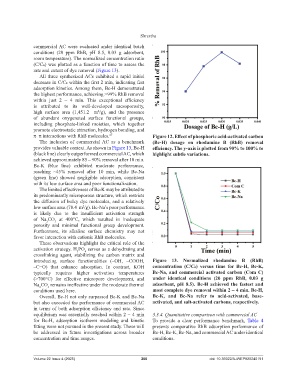
                commercial AC were evaluated  under  identical  batch
                conditions  (20  ppm  RhB,  pH  8.5,  0.03  g  adsorbent,
                room temperature). The normalized concentration ratio
                (C/C₀) was plotted as a function of time to assess the
                rate and extent of dye removal (Figure 13).
                  All three synthesized ACs exhibited a rapid initial
                decrease in C/C₀ within the first 2 min, indicating fast
                adsorption kinetics. Among them, Bc-H demonstrated
                the highest performance, achieving >99% RhB removal
                within  just  2  –  4  min.  This  exceptional  efficiency
                is attributed  to its well-developed  mesoporosity,
                high surface area (1,451.2  m /g), and the presence
                                            2
                of abundant oxygenated  surface functional  groups,
                including  phosphate-linked  moieties,  which together
                promote electrostatic attraction, hydrogen bonding, and
                π–π interactions with RhB molecules. 27             Figure 12. Effect of phosphoric acid-activated carbon
                  The  inclusion  of commercial AC as a  benchmark   (Bc-H) dosage on rhodamine B (RhB) removal
                provides valuable context. As shown in Figure 13, Bc-H   efficiency. The y-axis is plotted from 90% to 100% to
                (black line) clearly outperformed commercial AC, which   highlight subtle variations.
                achieved approximately 85 – 90% removal after 10 min.
                Bc-K (blue  line)  exhibited moderate  performance,
                reaching  ~45%  removal  after  10  min,  while  Bc-Na
                (green line)  showed negligible  adsorption,  consistent
                with its low surface area and poor functionalization.
                  The limited effectiveness of Bc-K may be attributed to
                its predominantly microporous structure, which restricts
                the diffusion of bulky dye molecules, and a relatively
                low surface area (78.4  m /g). Bc-Na’s poor performance
                                     2
                is  likely  due  to  the  insufficient  activation  strength
                of Na CO   at  400°C,  which  resulted  in  inadequate
                     2
                         3
                porosity and minimal functional group development.
                Furthermore,  its  alkaline  surface  chemistry  may  not
                favor interaction with cationic RhB molecules.
                  These observations highlight the critical role of the
                activation strategy. H PO  serves as a dehydrating and
                                   3
                                      4
                crosslinking  agent,  stabilizing the  carbon  matrix  and
                introducing  surface  functionalities  (–OH, –COOH,   Figure  13.  Normalized  rhodamine  B  (RhB)
                –C=O)  that  enhance  adsorption.  In  contrast,  KOH   concentration  (C/C₀)  versus  time  for  Bc-H,  Bc-K,
                typically  requires higher activation  temperatures   Bc-Na, and commercial activated carbon (Com C)
                (>700°C)  for  effective  micropore  development,  and   under identical conditions (20 ppm  RhB,  0.03 g
                Na CO  remains ineffective under the moderate thermal   adsorbent,  pH  8.5). Bc-H achieved the fastest  and
                      3
                  2
                conditions used here.                               most complete dye removal within 2 – 4 min. Bc-H,
                  Overall, Bc-H not only surpassed Bc-K and Bc-Na   Bc-K, and Bc-Na refer to acid-activated, base-
                but also exceeded the performance of commercial AC   activated, and salt-activated carbons, respectively.
                in terms of both adsorption efficiency and rate. Since
                equilibrium was essentially reached within 2 – 4 min   3.3.4. Quantitative comparison with commercial AC
                for Bc-H,  adsorption  isotherm  modeling  and  kinetic   To provide a clear  performance  benchmark,  Table  4
                fitting were not pursued in the present study. These will   presents  comparative  RhB  adsorption  performance  of
                be addressed in future  investigations  across broader   Bc-H, Bc-K, Bc-Na, and commercial AC under identical
                concentration and time ranges.                      conditions.


                Volume 22 Issue 4 (2025)                       200                           doi: 10.36922/AJWEP025240191

