


Page 205 - AJWEP-22-4
P. 205
Bombax ceiba-based carbons for dye removal


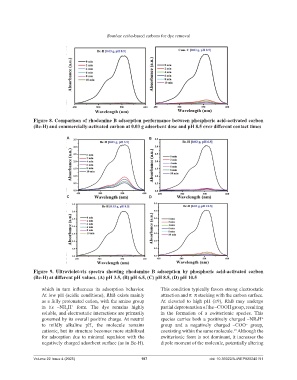
                Figure 8. Comparison of rhodamine B adsorption performance between phosphoric acid-activated carbon
                (Bc-H) and commercially-activated carbon at 0.03 g adsorbent dose and pH 8.5 over different contact times

                              A                                    B


                              C                                    D


                Figure  9. Ultraviolet-vis spectra showing  rhodamine B adsorption  by phosphoric acid-activated carbon
                (Bc-H) at different pH values. (A) pH 3.5, (B) pH 6.5, (C) pH 8.5, (D) pH 10.5

                   which  in  turn  influences  its  adsorption  behavior.   This condition typically favors strong electrostatic
                   At low pH (acidic conditions), RhB exists mainly     attraction and π–π stacking with the carbon surface.
                   as a fully protonated cation, with the amino group      At  elevated  to  high  pH  (≥9),  RhB  may  undergo
                   in  its  –NR H  form.  The dye remains highly        partial deprotonation of the –COOH group, resulting
                                 +
                              2
                   soluble, and electrostatic interactions are primarily   in the formation of a zwitterionic  species.  This
                   governed by its overall positive charge. At neutral   species  carries  both  a  positively  charged  –NR₂H⁺
                   to  mildly  alkaline  pH, the  molecule  remains     group  and  a  negatively  charged  –COO⁻  group,
                   cationic, but its structure becomes more stabilized   coexisting within the same molecule.  Although the
                                                                                                        15
                   for adsorption due to minimal repulsion with the     zwitterionic form is not dominant, it increases the
                   negatively charged adsorbent surface (as in Bc-H).   dipole moment of the molecule, potentially altering


                Volume 22 Issue 4 (2025)                       197                           doi: 10.36922/AJWEP025240191

