


Page 251 - AJWEP-22-4
P. 251
HEC-RAS study of Simike–Nzovwe drainage


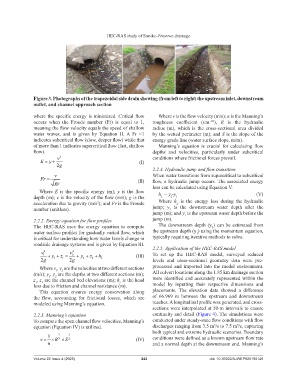
                Figure 3. Photographs of the trapezoidal side drain showing (from left to right) the upstream inlet, downstream
                outlet, and channel approach section

                where the specific energy is minimized. Critical flow   Where v is the flow velocity (m/s); n is the Manning’s
                occurs  when  the  Froude  number  (Fr)  is  equal  to  1,   roughness  coefficient  (sm ),  R is the hydraulic
                                                                                             -1/3
                                                                                           .
                meaning the flow velocity equals the speed of shallow   radius  (m),  which  is  the  cross-sectional  area  divided
                water  waves,  and  is  given  by  Equation  II.  A  Fr  <1   by the wetted perimeter (m); and S is the slope of the
                indicates subcritical flow (slow, deeper flow) while that   energy grade line (water surface slope, m/m).
                of more than 1 indicates supercritical flow (fast, shallow   Manning’s  equation  is  crucial  for  calculating  flow
                flow).                                              depths  and velocities,  particularly  under subcritical
                          v 2                                       conditions where frictional forces prevail.
                   E = +                                      (I)
                       y
                          2g
                                                                    2.2.4. Hydraulic jump and flow transition
                         v                                          When water transitions from supercritical to subcritical
                   Fr =                                       (II)
                         gy                                         flow, a hydraulic jump occurs. The associated energy
                                                                    loss can be calculated using Equation V.
                  Where  E  is  the  specific  energy  (m);  y  is  the  flow   h  = y -y                         (V)
                depth (m); v is the velocity of the flow (m/s); g is the   L  2  1
                acceleration due to gravity (m/s ); and Fr is the Froude   Where  h  is the energy loss during the hydraulic
                                            2
                                                                               L
                number (unitless).                                  jump;  y   is  the  downstream  water  depth  after  the
                                                                            2
                                                                    jump (m); and y  is the upstream water depth before the
                                                                                  1
                2.2.2. Energy equation for flow profiles            jump (m).
                The  HEC-RAS  uses  the  energy  equation  to  compute   The downstream depth (y ) can be estimated from
                                                                                              2
                water surface profiles for gradually varied flow, which   the upstream depth (y ) using the momentum equation,
                                                                                        1
                is critical for understanding how water levels change in   typically requiring iterative methods to solve.
                roadside drainage systems and is given by Equation III.  2.2.5. Application of the HEC-RAS model
                   v 1 2  +  y +  z =  v 2 2  +  y +  z +  h    (III)  To  set  up  the  HEC-RAS  model,  surveyed  reduced
                   2g    1  1   2g    2  2   L                      levels  and  cross-sectional  geometry  data  were  pre-
                  Where v , v  are the velocities at two different sections   processed and imported  into the model environment.
                          1
                            2
                (m/s); y , y  are the depths at two different sections (m);   All culvert locations along the 1.85 km drainage section
                       1
                         2
                z , z  are the channel bed elevations (m); h  is the head   were  identified  and  accurately  represented  within  the
                   2
                                                      L
                 1
                loss due to friction and channel resistance (m).    model by inputting  their respective  dimensions and
                  This  equation  ensures  energy  conservation  along   placements.  The  elevation  data  showed  a  difference
                the  flow,  accounting  for  frictional  losses,  which  are   of  66.969  m  between  the  upstream  and  downstream
                modeled using Manning’s equation.                   reaches. A longitudinal profile was generated, and cross-
                                                                    sections were interpolated at 50-m intervals to ensure
                2.2.3. Manning’s equation                           continuity and detail (Figure 4). The simulations were
                To compute the open channel flow velocities, Manning’s   conducted under steady-state flow conditions with flow
                                                                                               3
                                                                                                         3
                equation (Equation IV) is utilized.                 discharges ranging from 3.5 m /s to 7.5 m /s, capturing
                                                                    both typical and extreme hydraulic scenarios. Boundary
                      1    2    1
                   v =  ×   R ×  3  S                        (IV)   conditions were defined as a known upstream flow rate
                               2
                      n                                             and a normal depth at the downstream end. Manning’s
                Volume 22 Issue 4 (2025)                       243                           doi: 10.36922/AJWEP025190146

