


Page 249 - AJWEP-22-4
P. 249
HEC-RAS study of Simike–Nzovwe drainage

                standard  methodologies.   Recent  studies  emphasize   This study aims to evaluate the hydraulic performance
                                      3
                reliability-based  design  to  enhance  highway  safety,    of side drains along a 1.85 km stretch of the TANZAM
                                                                4
                and the strategic use of traffic control devices has been   Highway  between  Simike  and  the  Nzovwe  River.  It
                widely  documented.   Equally  important  is  drainage   addresses a gap in existing research by incorporating
                                  5,6
                design,  which  plays  a  critical  role  in  maintaining   specific energy variations into the design assessment,
                road safety and infrastructure integrity during adverse   thereby  capturing  transitions  between  subcritical  and
                weather  events.  Side  drainage  systems,  comprising   supercritical flows and their implications for sediment
                side drains, culverts, and other hydraulic structures, are   transport. By applying the HEC-RAS model, the study
                essential  for  managing  surface  runoff,  sediment,  and   provides practical  recommendations  for optimizing
                debris. Typically configured as trapezoidal channels for   side drain  design to reduce  sedimentation,  enhance
                cost-effectiveness and stability, these systems must be   flow efficiency, and ensure system sustainability under
                designed to meet  hydrologic  and hydraulic  demands.   extreme hydrologic conditions.
                However, inadequate design and maintenance can lead
                to inefficiencies, such as siltation and localized flooding.   2. Methods
                Poorly  performing  systems  exacerbate  flood  risks,
                particularly  in  rapidly  urbanizing  areas.  Wakjira  and   2.1. Study area
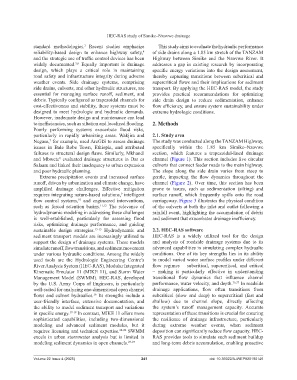
                Negasa,  for example, used ArcGIS to assess drainage   The study was conducted along the TANZAM Highway,
                       7
                issues  in  Bale  Robe  Town,  Ethiopia,  and  attributed   specifically  within  the  1.85  km  Simike–Nzovwe
                failures to structural design flaws. Similarly, Mkhandi   section,  which  features  a  trapezoidal-lined  drainage
                and  Mbwete   evaluated  drainage  structures in  Dar es   channel (Figure 1). This section includes five circular
                           8
                Salaam and linked their inadequacy to urban expansion   culverts that connect feeder roads to the main highway.
                and poor hydraulic planning.                        The slope along the side drain varies from steep to
                  Extreme precipitation events and increased surface   gentle,  impacting  the  flow  dynamics  throughout  the
                runoff, driven by urbanization and climate change, have   channel  (Figure  2). Over time,  this section  has been
                amplified  drainage  challenges.  Effective  mitigation   prone to issues, such as sedimentation  (silting)  and
                requires integrating nature-based solutions,  intelligent   surface  runoff,  which  frequently  spills  onto  the  road
                                                      9
                flow  control  systems,  and engineered  interventions,   carriageway. Figure 3 illustrates the physical condition
                                   10
                such as forced retention  basins. 11,12   The relevance  of   of the culverts at both the inlet and outlet following a
                hydrodynamic modeling in addressing these challenges   rainfall event, highlighting the accumulation of debris
                is  well-established,  particularly  for  assessing  flood   and sediment that exacerbates drainage inefficiency.
                risks, optimizing drainage  performance,  and guiding
                sustainable  design strategies. 13-15  Hydrodynamic  and   2.2. HEC-RAS software
                sediment transport models are increasingly utilized to   HEC-RAS  is  a  widely  utilized  tool  for  the  design
                support the design of drainage systems. These models   and  analysis  of roadside  drainage  systems due  to  its
                simulate runoff, flow transitions, and sediment movement   advanced capabilities in simulating complex hydraulic
                under various hydraulic conditions. Among the widely   conditions. One of its key strengths lies in its ability
                used  tools  are  the  Hydrologic  Engineering  Centre’s   to model varied water surface profiles under different
                River Analysis System (HEC-RAS), Modular Integrated   flow  regimes  –  subcritical,  supercritical,  and  critical
                Kinematic Emulator 11 (MIKE 11), and Storm Water    –  making  it  particularly  effective  in  understanding
                Management Model (SWMM). HEC-RAS, developed         transitional  flow  dynamics  that  influence  channel
                by the U.S. Army Corps of Engineers, is particularly   performance, water velocity, and depth. 26,27  In roadside
                well-suited for analyzing one-dimensional open channel   drainage  applications,  flow  often  transitions  from
                flows and culvert hydraulics.  Its strengths include a   subcritical  (slow  and  deep)  to  supercritical  (fast  and
                                          16
                user-friendly  interface,  extensive  documentation,  and   shallow)  due  to  channel  slope,  directly  affecting
                the ability to model sediment transport and variations   the  system’s  runoff  management  capacity.  Accurate
                in specific energy. 17-19  In contrast, MIKE 11 offers more   representation of these transitions is crucial for ensuring
                sophisticated  capabilities,  including  two-dimensional   the  resilience  of  drainage  infrastructure,  particularly
                modeling  and advanced  sediment  modules, but it   during  extreme  weather  events,  when  sediment
                requires licensing and technical expertise. 20-22  SWMM   deposition can significantly reduce flow capacity. HEC-
                excels  in  urban  stormwater  analysis  but  is  limited  in   RAS provides tools to simulate such sediment buildup
                modeling sediment dynamics in open channels. 23-25  and long-term debris accumulation, enabling proactive


                Volume 22 Issue 4 (2025)                       241                           doi: 10.36922/AJWEP025190146

